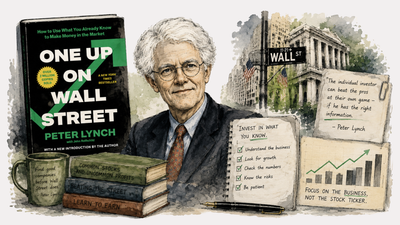
Nothing Ever Travels in a Straight Line
Except a sprinter in the 100-meter dash. Investing takes longer, and the finish line is considerably less obvious.

Glavcot Insights began with a particular curiosity: overlooked businesses, including those that might be undervalued.
There is something compelling about discovering an enduring product, a defensible competitive position or a thoughtful steward behind an unremarkable stock ticker.
That curiosity remains. But the questions have widened: how businesses create value, how investors handle uncertainty, and what history can contribute to our judgement.
Company research remains central. Its usefulness, however, extends beyond finding another stock to own. Understanding a business may give someone a sound reason to pass. Another reader may conclude that selecting and monitoring individual companies requires more time or conviction than they wish to commit.
However, participating in the long-term development of businesses does not require everyone to identify the next exceptional company. Diversified equity ownership offers another route, with market risk and potentially long periods of disappointing returns.
Glavcot’s role is to examine these ideas and make their assumptions clearer. The decisions remain with (you) the reader.
Whichever route we take, we still have to live through the middle.
We tend to describe successful investments by their beginning and their end: what was paid, and what it eventually became worth.
Between those points lie disappointing quarters, changing expectations and stretches when an apparently sound decision offers little reassurance.
On a historical chart, those periods occupy a few centimetres. In an investor’s life, they can occupy years.
When headlines reach for words like “bloodbath,” the latest fall can feel like the only thing that matters. Rising markets produce their own version of this confidence: recent gains begin to look permanent.
Neither tells us enough about what comes next.
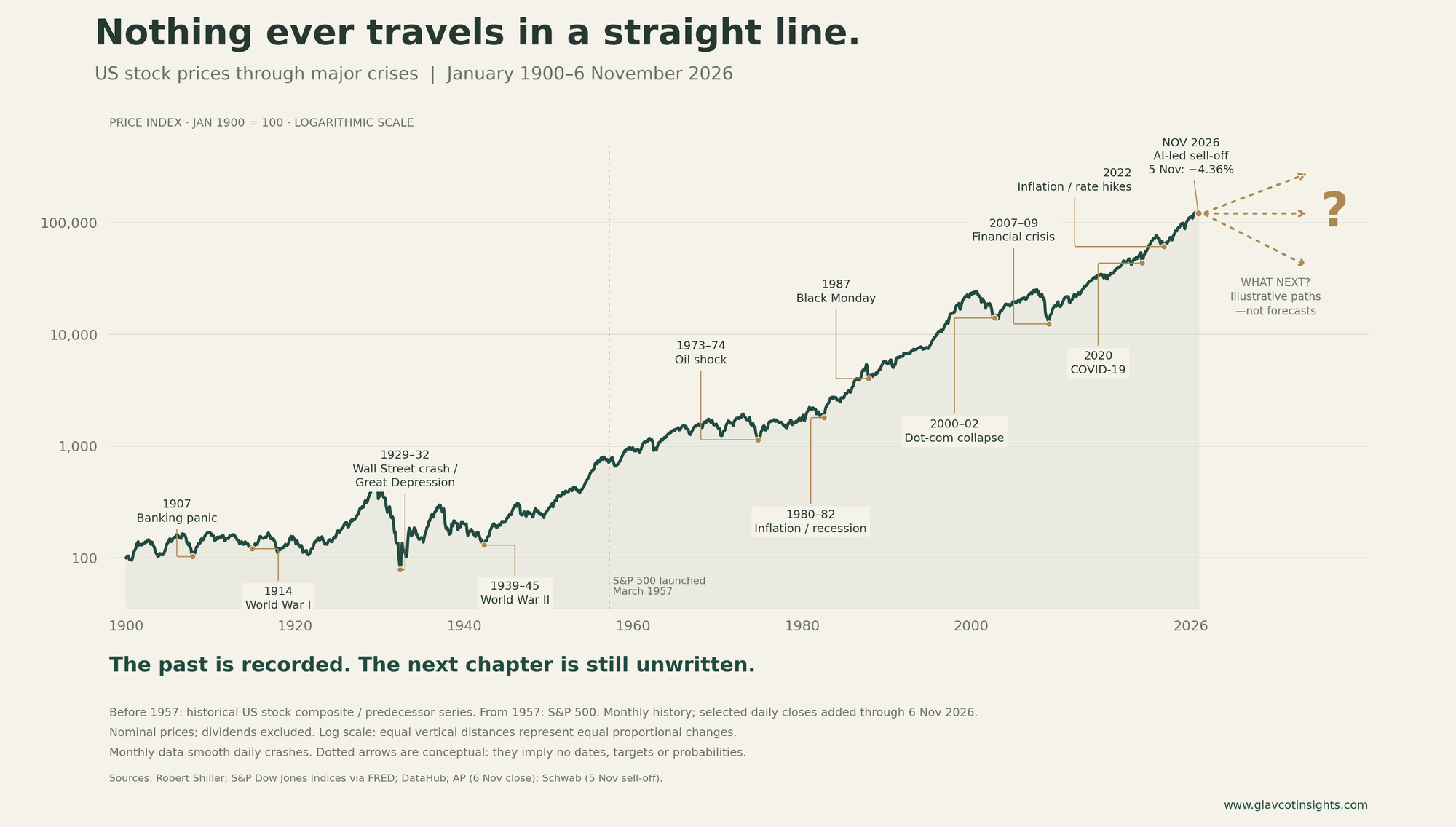
Time matters. So does the starting point.
This US market history shows why patience can be rewarding, but ten years is no guarantee. Japan offers a reminder: the Nikkei 225 took until 2024 to surpass its 1989 closing high, excluding dividends.
In hindsight, remaining invested in US equities through two world wars looks rewarding. There was, of course, the rather important matter of surviving them.
A longer horizon gives an investment more time to work. The market chosen, the price paid and the history we happen to live through still shape the outcome.
In Three Lessons from 126 Years of Market History, I explored the UBS Yearbook’s evidence on ownership of productive businesses, changing industries and the economic consequences behind the headlines.
The long record gives us reasons to take equity ownership seriously. Businesses can generate earnings, reinvest and build value through changing conditions. But 126 years is not our own investing horizon. That history cannot promise a recovery within the years available to us.
This brings us to the question in The Part We Control and the Part We Don’t.
We cannot choose tomorrow’s market response. We can choose how carefully we examine an investment, which assumptions we accept, what price we pay and whether we reconsider when the evidence changes.
That last responsibility matters. In The Price Is Falling. Now What?, BYD, Amazon and Tesco showed why falling prices do not all call for the same response. Sometimes the capabilities supporting ownership survive a difficult period. Sometimes the original case deteriorates.
Patience needs something to rest on.
An enduring product, a durable moat and capable stewardship can help a business increase its earning power over time. The investor still has to assess whether those qualities remain intact.
The price paid also matters: does it leave room for a satisfactory return?
These are questions about the particular business we own. A diversified market’s long-term record offers perspective, but it cannot answer them for us. Only time will reveal how that company’s story unfolds.
 Ryan Gallinera

 Ryan Gallinera
 Ryan Gallinera
These earlier pieces reflect how Glavcot Insights has developed: from a curiosity about overlooked businesses to a broader examination of what ownership requires.
History provides perspective. Research helps us assess what we own. Our decisions determine how we respond as the evidence develops. None gives us advance knowledge of the ending.
Nothing ever travels in a straight line. Long-term progress can contain painful setbacks, and a setback alone cannot tell us the eventual direction.
The upward-sloping chart we admire in hindsight was once an uncertain journey.
And here we are, living through our own part of that history. The right-hand side is still blank.
Get new research, company updates and analytical perspectives from Glavcot Insights. If you don’t see the confirmation email, check your spam folder.