
Reading Peter Lynch Again, From the Other Side of Research
Ten lessons from a new foreword, seen differently further along the investing journey.
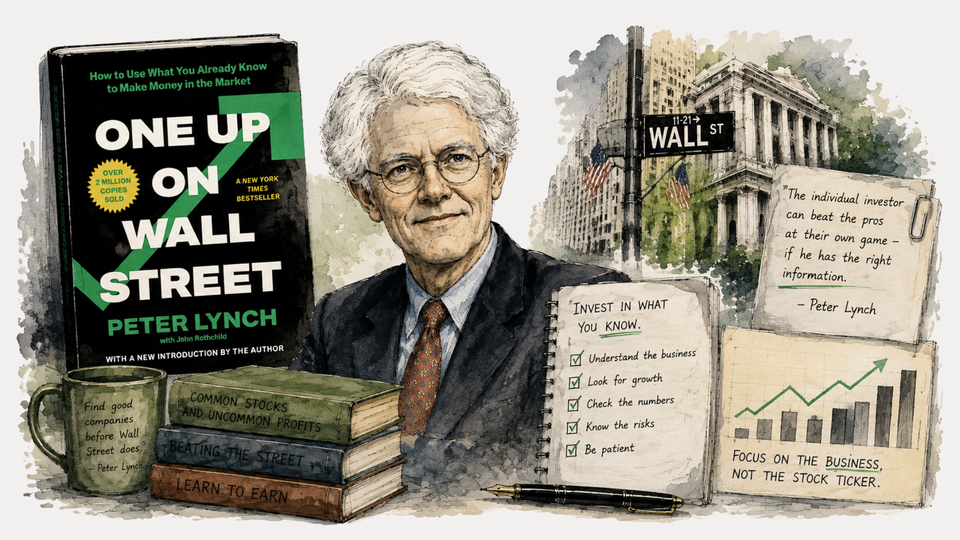
One Up on Wall Street is not a new book. First published in 1989, Peter Lynch's argument that ordinary investors can find opportunities by paying attention to businesses around them has survived decades of market cycles.1
What follows is my take on those ten lessons. Not so much a summary of the book, but a reflection on the principles that still stand out nearly four decades after it was first published.
Lynch begins with time.
The earlier capital is put to work, the longer compounding has to operate. Yet investors can spend years waiting for the next correction, recession or seemingly better entry point.
There will always be reasons to wait.
Waiting may feel disciplined, but it still assumes we can recognise a better time to enter.
Lynch describes investing as turning over rocks. Study ten companies and perhaps one will be interesting. Study twenty and perhaps there will be two.
Good ideas are scarce. The objective is not to force every company into an investment thesis. Most research should probably lead nowhere.
The advantage may simply come from continuing to look.
There is also an asymmetry. A failed investment can lose what was committed to it. An exceptional business, held long enough, can return multiples of the original investment. Lynch's name for the second outcome is the tenbagger.4
You do not need to be right all the time.
But when you are right, it has to be allowed to matter.
Lynch separates two very different opportunities.
One is owning a great company for a long time. The other is buying a troubled business or industry when conditions begin to improve.
They require different thinking.
A compounder deserves patience while the business continues creating value. A turnaround depends on a change in conditions, and the thesis may expire once that change has played out.
Confusing the two can be expensive.
Before valuation comes a more fundamental question.
What exactly am I buying?
Lynch uses baseball as a metaphor for a company’s lifecycle. The “inning” refers to the stage of development the business has reached.
A company can already have performed extraordinarily well and still have much further to go.
Lynch points to Walmart and Costco. Investors could have seen their earlier gains and concluded that the opportunity had passed, while the businesses themselves were still relatively early in their expansion.5
Share-price history tells us what has happened.
Business runway asks what might still be possible.
How much of the market remains? Can the model travel? Can capital still be reinvested productively? Is growth becoming harder?
Sometimes what looks late on the share-price chart is still early in the business.
This may be Lynch's most repeated idea, and one of the easiest to misunderstand.
"Invest in what you know" does not mean buying a company simply because we use its products, visit its stores or recognise its brand.
Familiarity tells us where to look. It does not complete the research.
Lynch quickly moves into cash, debt, balance sheets, industry economics and competitive advantages. Knowing the product is not the same as knowing the business.
What generates its economics? Where does the risk sit? What funds growth? Why do customers choose it? What could weaken it?
Lynch calls it understanding the company's secret sauce.6
I would put it more simply. If I own part of this business, I should be able to explain why. Not why the share price should rise next month. But why the business deserves my capital.
An investment rises and we become nervous about losing the gain. Another falls and we become reluctant to realise the loss.
So we sell the successful business and give the struggling one more time.
Psychologically, that can feel prudent. Economically, it may be the opposite. The decision should return to the business.
Has the thesis changed? Has the competitive position deteriorated? Has the balance sheet weakened? Is the opportunity reaching its natural limits?
If not, a rising share price alone does not mean the business has finished creating value.
Sometimes the greater mistake is not buying the wrong company.
It is selling the right one too early.
Large, well-known companies attract enormous analytical attention. That does not make them bad investments, but it raises another question.
Where is the market less certain?
Lynch points to Vistra, a Texas utility and power company that he describes as a tenbagger over the preceding five years, despite belonging to an industry normally associated with slow growth.7
Categories can become shortcuts.
Utility. Retailer. Bank.
Commodity producer. REIT.
Technology company.
Labels help organise businesses, but they can also hide what is changing underneath them.
Sometimes the opportunity is not hidden because nobody can see the company.
It is hidden because everybody thinks they already understand it.
Analysis cannot prevent the market from disagreeing with us.
Lynch experienced repeated market declines while managing the Magellan Fund, falling further than the market in each of them and staying invested throughout.8 His point is not to ignore falling prices. It is to distinguish price from fundamentals.
A stock falling 30% does not automatically mean the thesis is broken.
Neither does it automatically mean the stock is cheap.
Return to the business. Has earning power changed? Has debt become dangerous? Has the competitive position weakened? Has something changed the original reason for ownership?
If yes, the decline may be telling us something.
If not, volatility may simply be part of equity ownership.
Knowing the difference is difficult.
Living with it can be harder.
Lynch is dismissive of attempts to predict the economy, interest rates or market direction.
These things matter. But recognising that something matters is different from believing we can consistently predict it.
Investors can spend enormous amounts of time forecasting recessions, rates and markets while spending remarkably little time understanding the company they actually own.
Perhaps the better distinction is between awareness and dependence.
Understand the environment in which a business operates. But if the investment thesis requires several unknowable forecasts to be correct, the thesis may be more fragile than it appears.
Lynch ends with patience.
He bought Home Depot early, understood the concept, and watched the shares triple over the three years he held them.
Then he sold.
The company continued expanding and the eventual long-term return became extraordinary.9
Apple was different. Lynch knew the product, saw its economics and recognised its strong balance sheet. Yet he never connected those observations into an investment.10
Even extraordinary investors miss extraordinary businesses.
They sell too early. They overlook opportunities. They make mistakes.
Patience therefore cannot mean holding everything forever.
It means giving a sound thesis enough time to work while continuing to test whether the reasons behind it remain intact.
Taken together, Lynch's ten lessons are more than a stock-picking checklist.
Search widely. Understand deeply. Know what you own and where it sits in its lifecycle. Separate price from fundamentals. Accept uncertainty. Give exceptional businesses enough time to become exceptional investments.
And accept that mistakes are part of the process.
For me, that is one of the broader lessons here. Investing does not require being right about everything. It requires surviving what we get wrong and allowing what we get right to matter.
Research establishes the reasons for ownership.
Time tests them.
And eventually, the business tells us whether we understood it at all.
Follow new research, company updates and analytical perspectives from Glavcot Insights. If you don’t see the confirmation email, check your spam folder.