
Nike Is the Headline. The Reshuffle Is the Story.
Taken together, the reshuffle tells us more about how the market has been priced than about which of these businesses are better. That is what an index is built to show.

Nike leaving the S&P 100 made headlines this week. Three other companies are leaving with it, and four are taking their places. Most of that received far less attention.
That asymmetry is the interesting part. Eight companies changed standing, but one name dominated the story. This says more about how we read index membership than it does about any of the eight businesses.
Every company entering was already in the S&P 500, and every company leaving stays in it. The S&P 100 is drawn from the S&P 500,2 so what happened is a promotion or a demotion inside a group all eight already belonged to. None of these eight companies entered or left the S&P 500.
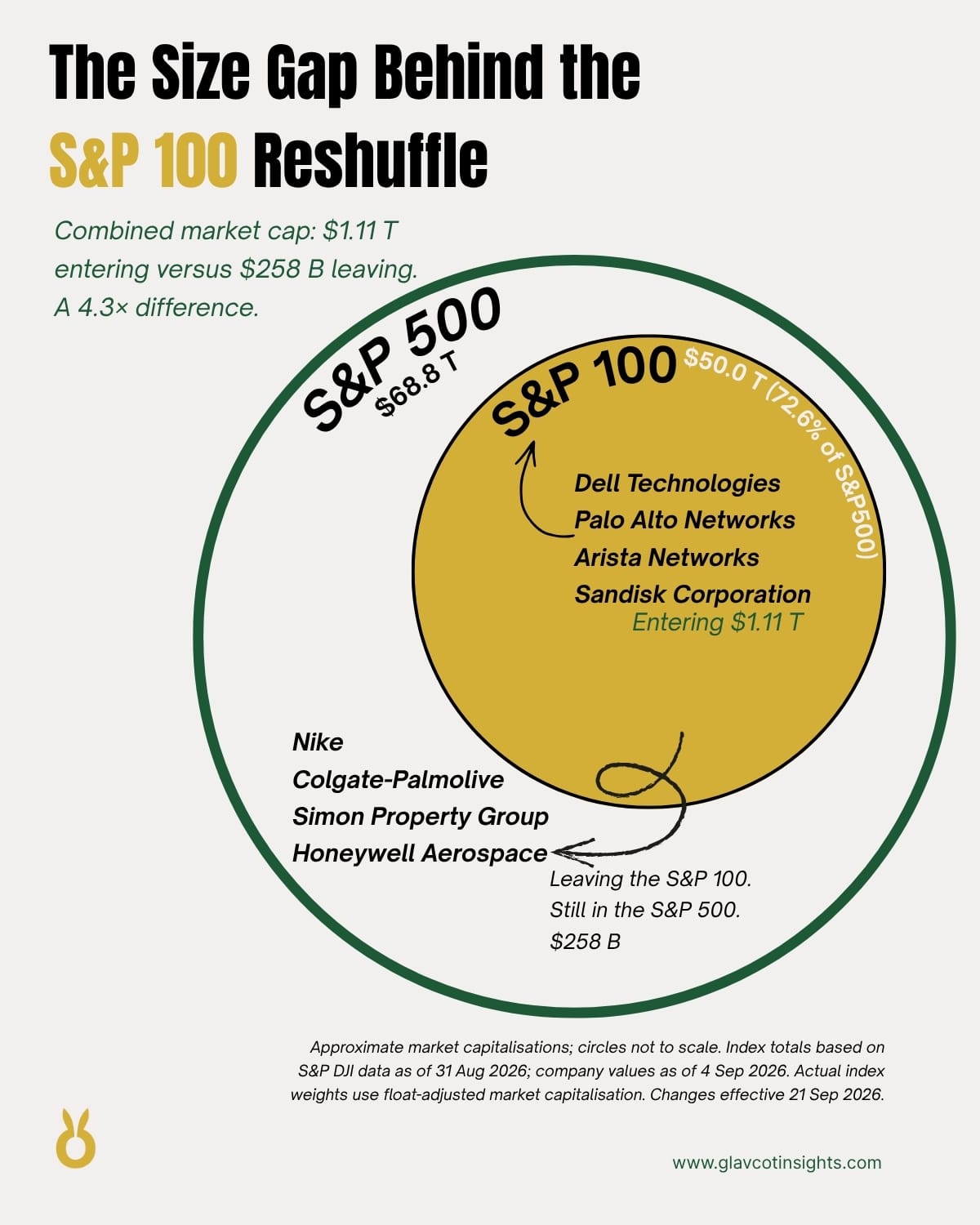
The announcement does not pair the names either. It lists four additions and four deletions and describes no company as anyone's replacement.1 Dell did not beat Nike. Palo Alto Networks did not defeat Colgate-Palmolive. The index re-sorted a list it already held.
Entry can reflect growing market strength, and exit can reflect decline. But neither tells us much about business quality or future returns.
The criteria tell us something, but not everything. They screen for size, liquidity, tradability and a minimum level of profitability: large enough, liquid enough, free-floating enough, and profitable under generally accepted accounting principles in the most recent quarter and across the trailing four.4 For the S&P 100, constituents are generally drawn from the largest S&P 500 companies with exchange-listed options, with sector balance also considered.5 The final decision rests with the Index Committee.
In other words, the screen establishes a minimum standard. It does not rank the businesses that pass.
Honeywell Aerospace shows why that distinction matters. It took its seat at the end of June, inheriting the one its parent had held before the aerospace business was separated out,6 and is losing it before completing a full quarter as a constituent. Its brief stay says more about the mechanics of the reorganisation than about the quality of the aerospace business.
Nike is the harder case because its removal does track a real decline in relative market value. Even then, the index cannot answer whether Nike is a good business to own from this point.
Four entrants from a single sector is still worth noticing. Information Technology already accounted for 37.9% of the S&P 500 at the end of August, against 12.3% for Financials, the next largest sector.7
The real exposure is wider than that. Alphabet and Meta sit under Communication Services, while Amazon and Tesla sit under Consumer Discretionary.8 Meta remains overwhelmingly advertising-driven, Alphabet took 73% of its 2025 revenue from advertising,9 and Amazon earned more than half its 2025 operating income from Amazon Web Services rather than from retail.10 Four of the largest technology businesses in the market are filed somewhere other than technology.
Classifications are still useful. They organise companies, make comparison possible, and give a shared vocabulary for describing how a market is built. But they are labels applied by a committee, and they record where a company was filed rather than what drives its economics.
Which means the market carries more technology exposure than the sector table shows, not less. That is what makes this reshuffle worth a second look, rather than the four names involved. Capital has continued to gather in businesses built on software, computing and networks, whether or not they are filed under that heading.
Taken together, the reshuffle tells us more about how the market has been priced than about which of these businesses are better. That is what an index is built to show. It records where value has accumulated and which companies have become most representative of the market today. It does not tell us which will create the most value from here.
That is where the investment question begins.
Does the reshuffle argue for owning the hundred largest companies, and the four newest of them most of all? Or is there something worth examining among the four leaving, where expectations have already come down?
Neither follows. Entry is not a recommendation and exit is not a discount. A company can grow large enough for consideration through rising profits, a higher valuation multiple, or both. Size is a large part of the screen, but it is not the conclusion.
What the reshuffle gives us is eight businesses whose relative standing has shifted enough to deserve another look. Whether any of them is a good business at a sensible price is a separate question, and the index cannot answer it.
Follow new research, company updates and analytical perspectives from Glavcot Insights. If you don’t see the confirmation email, check your spam folder.