
SRS Saves Tax. But What Does It Commit?
Looking beyond the tax saving to the cash you still need to set aside.
In Singapore, the Supplementary Retirement Scheme is often framed around a few familiar benefits: save for retirement, reduce your taxable income, invest for the longer term.
Tax saved is nice. Cash committed is the number I wanted to see.
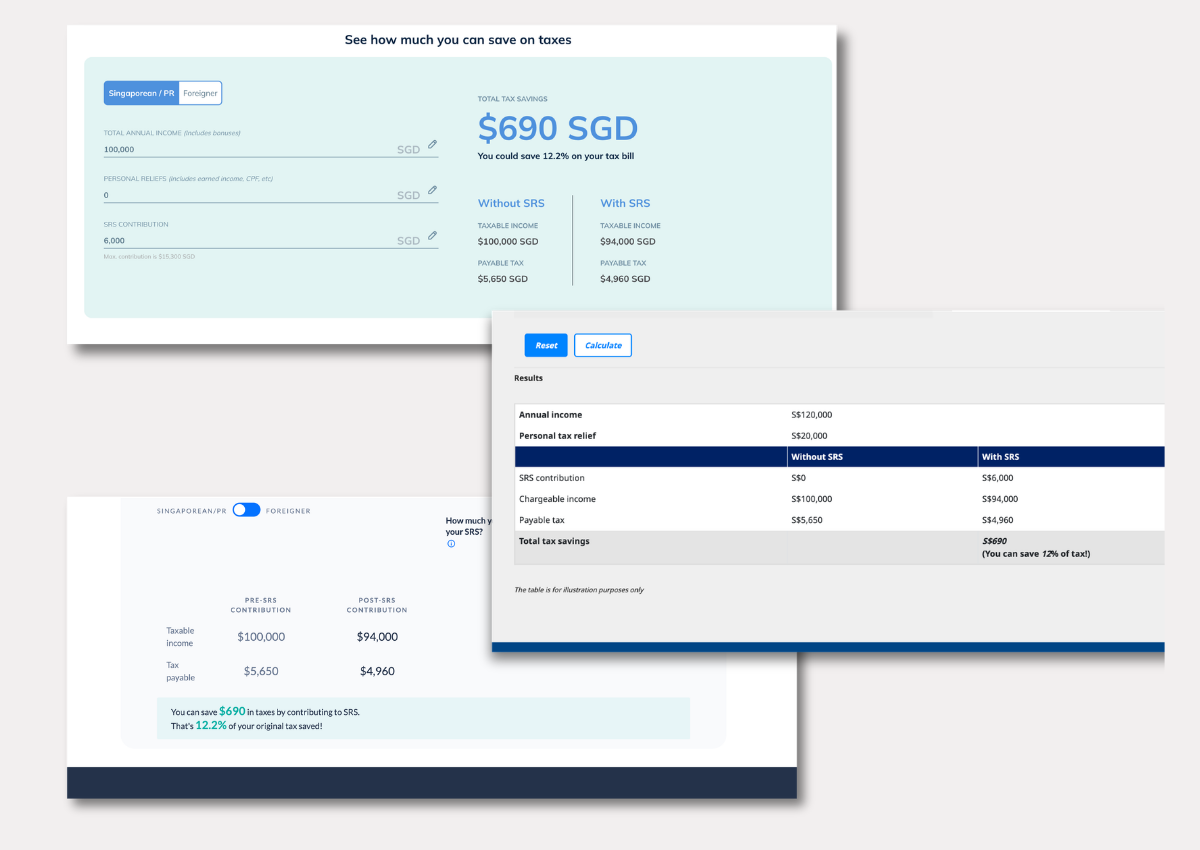
I found that most online SRS calculators make the tax saving the headline.
Useful. But for my own planning, I wanted the other number in bold too:
How much cash am I actually committing after the SRS contribution and remaining tax are considered together?
So I built a simple calculator to see it.
Take a simple example.
Suppose someone has S$100,000 of chargeable income and decides to contribute S$500 a month to SRS.
The usual question is:
How much tax does that contribution save?
For my own planning, I wanted to add another:
How much cash am I still committing overall?
| Before SRS | After SRS | |
|---|---|---|
| Chargeable income | S$100,000 | S$94,000 |
| Annual tax | S$5,6501 | S$4,960 |
| SRS contribution | — | S$6,000 |
| Tax saved | — | S$690 |
| Total annual cash commitment | — | S$10,960 |
| Monthly equivalent | — | ~S$913 |
Similarly to the other calculators, we can see that the SRS contribution reduces the tax bill.
But before we get too pleased with the tax saving, there are still two amounts to fund: the money going into SRS and the tax that remains payable after the relief.
Of course, the S$6,000 going into SRS is not an expense in the same sense as tax. It is still your money.
But it still has to leave your pocket today.
It has simply moved from available today to committed for retirement.
That is the distinction I wanted to make visible.
Note: In the above table, monthly figures are shown as an annualised equivalent. Actual SRS contributions and tax payments may occur at different times.
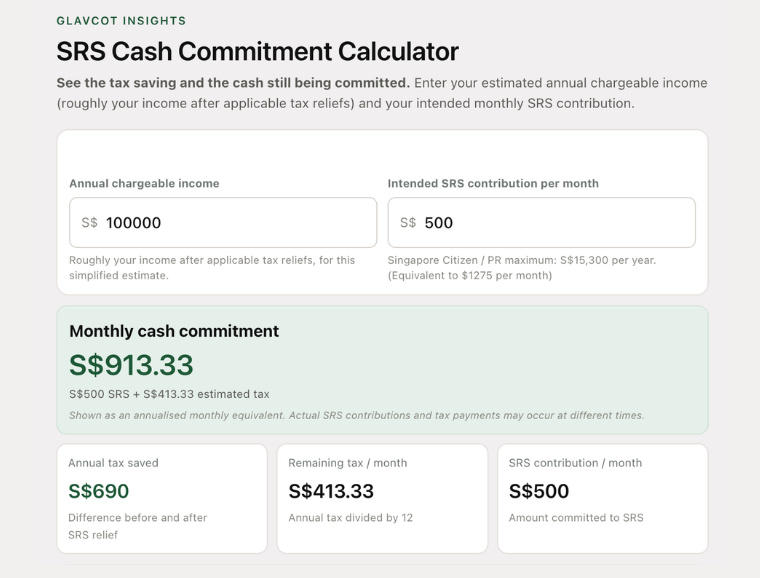
I built a simple calculator to look at the same question from a cash-flow perspective: not just the tax saved, but the SRS contribution and remaining tax payable together.
SRS can be useful.
Contributions qualify for tax relief, subject to the applicable limits. For Singapore Citizens and Permanent Residents, the current annual contribution cap is S$15,300.3
If someone already intends to set aside money for retirement, has sufficient liquidity and is paying meaningful income tax, the tax relief can be valuable.
But that is different from saying the maximum contribution is automatically the right amount.
For my own planning, the question is not only:
How much tax can I save?
It is also:
How much cash can I comfortably commit?
For someone with strong cash reserves, that may be an easy decision.
But if some of the cash being set aside today might be needed within the next year or two, the trade-off becomes more relevant. You can always stop making future contributions. What has already gone into SRS is less flexible.
The tax benefit can still be attractive.
The liquidity trade-off is still real.
Some people may treat SRS as a year-end exercise.
They receive a bonus, review their tax position and make a lump-sum contribution. Others may prefer to think about it monthly.
S$500 a month.
S$800 a month.
Or enough to reach the annual contribution limit.
The timing may feel different. The economics do not.
A S$6,000 annual contribution is still S$6,000 of cash moved from available today to committed for retirement.
And not to forget, the remaining tax bill still has to be paid as well.
There is also a tendency to think of SRS as tax-free retirement money.
That is not quite right.
For qualifying withdrawals after the prescribed retirement age, only 50% of the amount withdrawn is subject to tax.4
That does not necessarily mean a large tax bill.
IRAS gives an example of an individual withdrawing S$40,000 a year. Only S$20,000 is treated as taxable income, and at current resident tax rates that can result in zero tax payable, assuming there is no other taxable income.4
So the actual tax on retirement withdrawals may be low (or even zero) depending on the amount withdrawn and the individual's other taxable income at the time.
That is part of what can make SRS useful.
Tax relief is received when contributing. The money can then be invested. Qualifying withdrawals later may be taxed more lightly. But again, that only helps if the money can genuinely remain committed.
The usual SRS calculator answers an important question:
How much tax could I save?
For my own planning, I wanted to add another:
How much cash am I committing in total?
For illustration only:
Using a hypothetical S$100,000 chargeable income and S$500 monthly SRS contribution:
Tax saved: S$690 a year
SRS contribution: S$500 a month
Remaining tax: about S$413 a month
Monthly cash commitment: about S$913
That is the number I would want beside the tax saving.
Not because SRS is unattractive. But because tax efficiency and liquidity are two different things.
Sometimes the better question is not:
How much can I save in tax?
It is:
How much can I comfortably commit?
Follow new research, company updates and analytical perspectives from Glavcot Insights. If you don’t see the confirmation email, check your spam folder.