9 min read

The Price Is Falling. Now What?

What three investment cases reveal about looking past the price.
The Price Is Falling. Now What?
As I look across some investments sitting in the red, a familiar feeling creeps in. At first, it is manageable.

One bad day? Fine.
A bad week? Annoying.
A few bad months? Now we have a situation.

Soon you are not just questioning the investment.

You are questioning yourself. Your process. Your judgement.
Your supposed ability to read a business.

Eventually, you stop opening the brokerage app altogether. Because obviously, if you do not look at the share price, it cannot hurt you.
It can. I checked.

Then the questions start coming.

“Why did you buy this stock in the first place?”

Usually from someone who bought nothing and is therefore undefeated.

The market has an opinion. Your friends have one. Even the friend who tipped you a random stock six months ago, and has since forgotten it, has one. Meanwhile, the share price has been asking you the same question every morning.

So I started wondering how the great investors dealt with this.

Not the polished version we read about afterwards. The part in the middle. When the position was down. When the numbers looked ugly. When nobody knew yet whether patience was conviction or just stubbornness wearing a nicer suit.

Did they hold?

Did they add?

Did they sell?

And what were they actually looking at while the rest of us were refreshing the price like it owed us an explanation? Surely they never hid from the brokerage app.

So I went looking.

Three cases. Three falling share prices.
And not the same decision each time.

The first begins with a company most people know through Berkshire.


There is a familiar story about BYD.

In 2008, Berkshire Hathaway paid about US$230 million for roughly 10% of the Chinese battery and car maker, at HK$8 per share.1 It became one of Berkshire's most successful investments outside the United States. But the Berkshire story came later.

Li Lu owned BYD first. He began investing in 2002 and spent years studying the business and its founder, Wang Chuanfu, before introducing the company to Munger.2

What followed is easy to admire in hindsight. It was much harder to live through.

BYD shares peaked at HK$85.50 in October 2009. By late August 2011 they had closed at HK$16.18, a decline of roughly 81%.3
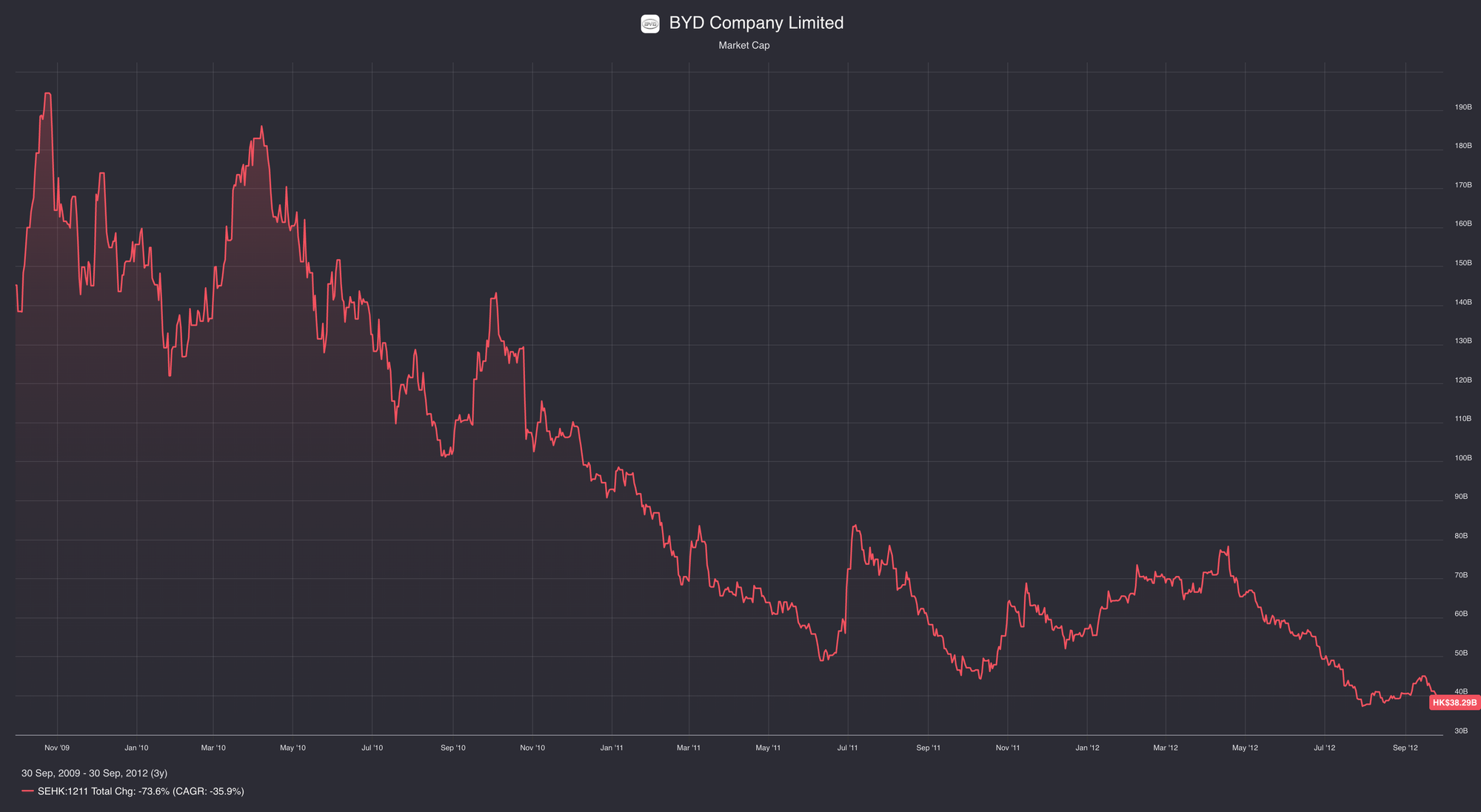
Three years, one direction. BYD's market value fell 73.6% between September 2009 and September 2012. Holding meant looking past this line, not at it.

Li Lu remained an owner.

He did not lose 81% on his investment. His entry was years earlier and far lower. But as a long-term owner, he watched most of BYD's quoted value disappear. And the share price was not the only thing going wrong. Vehicle sales weakened. Net profit fell 44% in 2011.4 In 2012 it fell a further 94%, to RMB81 million.5

That removes the easy explanation. This was not a nervous market overlooking a healthy business. The business itself was under pressure.

So what exactly had broken?

Li Lu's case never rested on one year of sales or earnings. It rested on the organisation. Its engineering culture. Its manufacturing discipline. Its battery expertise. A founder able to move into large new markets.

Those capabilities were under strain. The question was whether they had disappeared.

We know the answer now. Investors in 2011 did not.

In July 2021, Himalaya Capital sold about 10.8 million BYD H-shares for roughly HK$2.44 billion. It still held about 62.9 million shares afterwards.6 Nearly two decades had passed since the first purchase.

The interesting part is not that BYD eventually went up. It is what an owner was supposed to look at while the outcome was still unclear.


Amazon presents a different problem.

Today it is hard to separate Amazon from what it became. Prime, AWS, logistics and advertising are already part of the story. That makes it easy to forget what ownership felt like before the result was obvious.

Nick Sleep and Qais Zakaria ran the Nomad Investment Partnership from 2001 to 2014. By mid-2007, Amazon was roughly one sixth of Nomad's portfolio.7 It was already a substantial bet.

Then came 2008. Nomad fell 45.3%.8 Amazon fell with it.
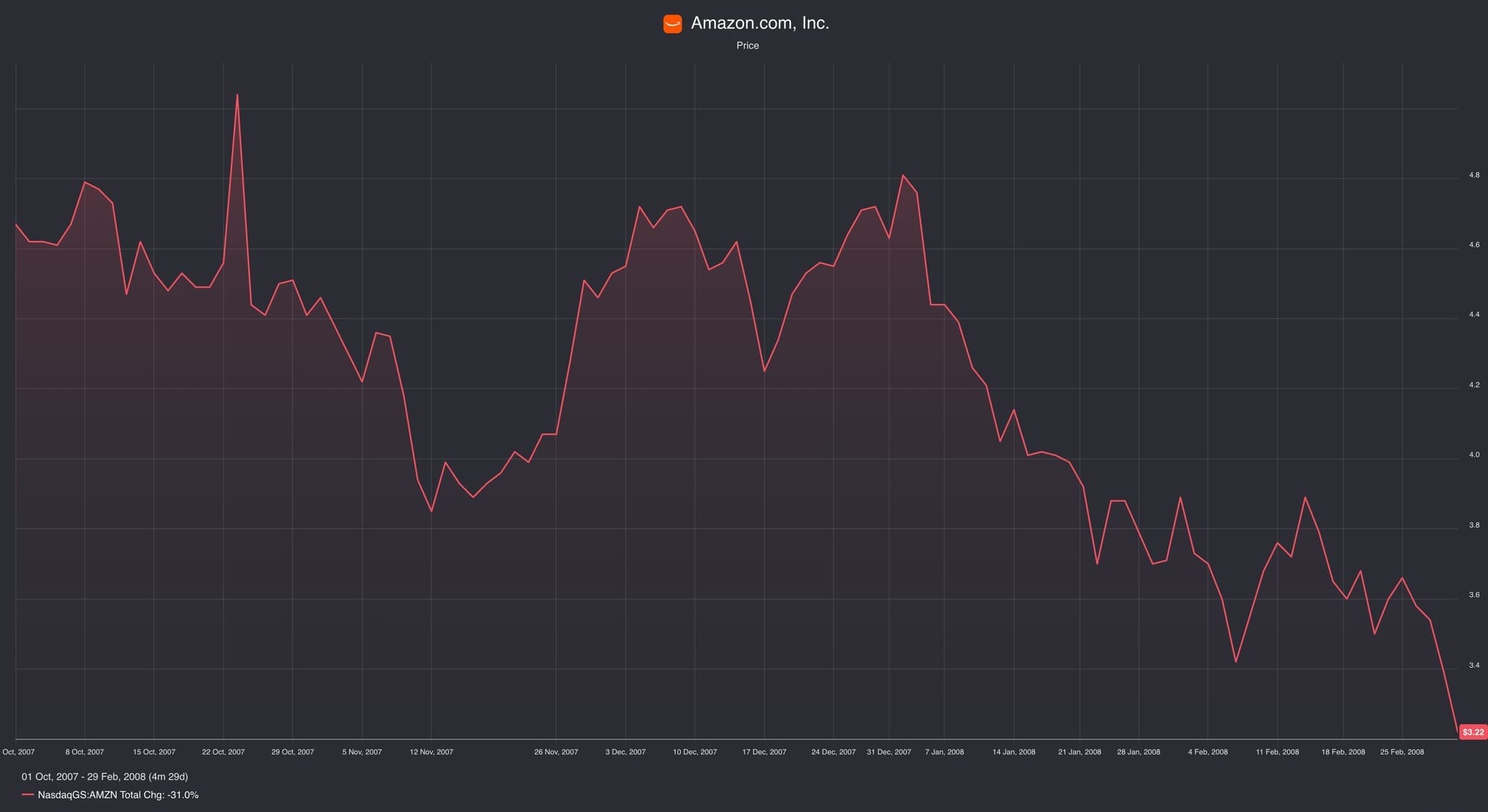
Amazon share price, October 2007 to February 2008. Down 31% before the worst of 2008 had even begun. The market was already changing its mind. Whether the business had changed was a separate question.

Sleep did not answer with patience alone. He kept looking underneath the price.

He focused on what he called scale economies shared. As Amazon grew larger and more efficient, it returned part of those gains to customers through lower prices, better service and greater convenience. Done repeatedly, scale strengthened the customer proposition instead of simply widening margins.

That was what Sleep was watching.

On the busiest day of the 2008 Christmas run-up, Amazon's order volumes were still 16% higher than a year earlier. Industry-wide U.S. retail sales fell nearly 10% in December.9

The share price was deteriorating. The customer proposition was not.

A falling price tells an owner the market has changed its mind. It cannot tell him whether the business has changed with it.

Nomad held Amazon for close to a decade. The company first appears among the Partnership's investments in the December 2005 letter.10 The shares were finally sold in 2014, when Sleep and Zakaria wound up the Partnership and returned the money to their partners.

Even that sale was not a verdict on the business. Sleep later wrote that selling stakes built up over years felt wrong. They had a few superb businesses and no intention of selling them to fund something lesser.11


Then there is Warren Buffett.

Coca-Cola. American Express. GEICO. The Washington Post. His record makes it easy to equate good investing with holding for a very long time.

Tesco shows why that is incomplete.

At the end of 2011, Berkshire owned about 292 million Tesco shares.12 A year later, that had increased to about 415 million.13 Buffett had not merely waited. He had added.

Then his view began to change.

In 2013, Buffett became concerned about management and sold 114 million shares.

He could have sold more. He did not.

In 2014 the evidence became harder to ignore. Market share fell. Margins contracted. Accounting problems surfaced.
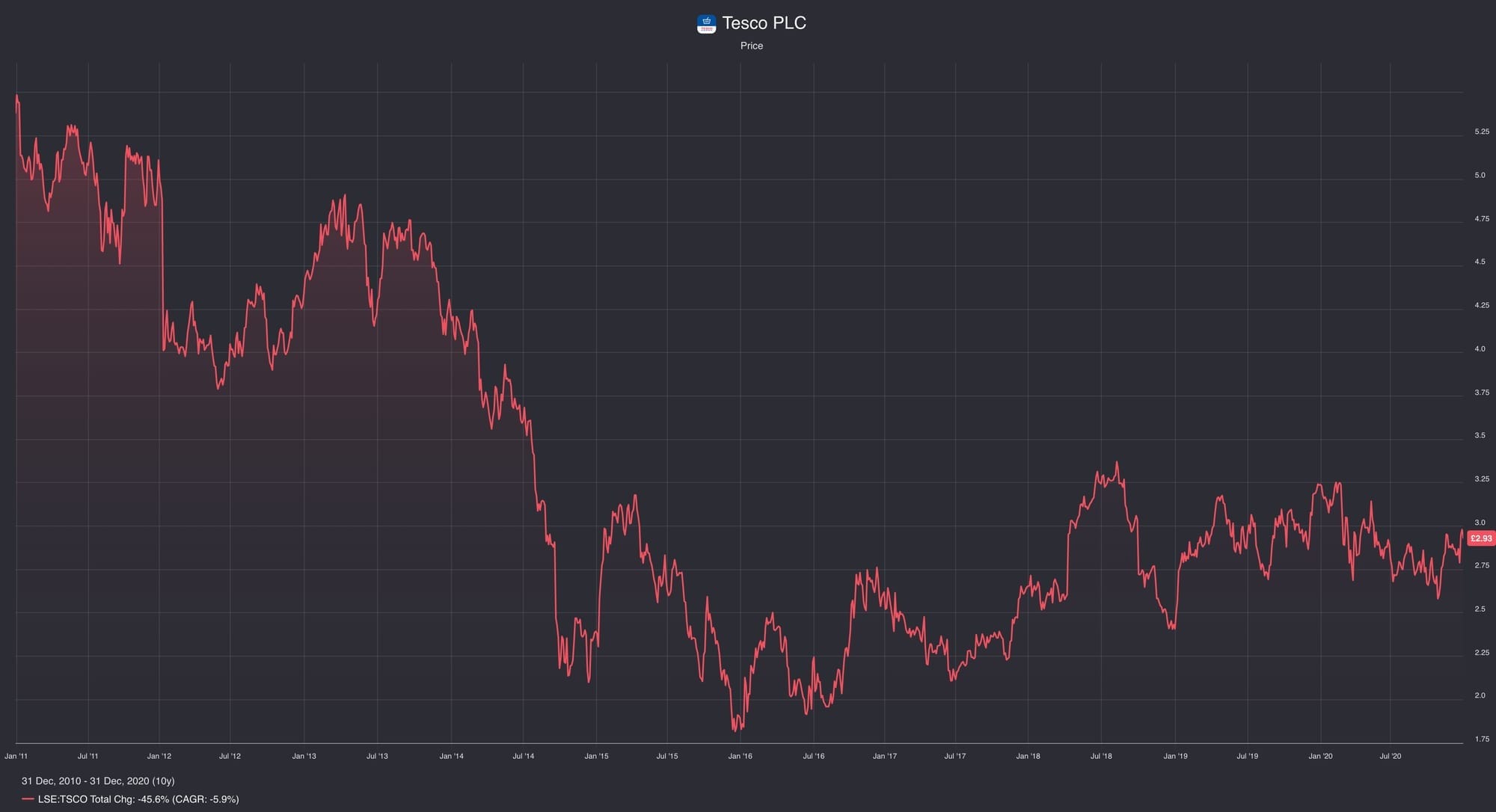
Tesco share price, 2011 to 2020, down 45.6%. Buffett bought more after the first fall. He was still selling during the second. A decade later, the shares had not regained their 2011 level.

This was no longer a disappointing year. The competitive position was weakening. Management credibility was damaged. So was confidence in the reported numbers.

Berkshire exited with an after-tax loss of US$444 million. Buffett later wrote that an attentive investor would have sold earlier. He called his delay a big mistake.14

Tesco matters because it changes the lesson from the first two stories. Sometimes the difficult part is holding on. Sometimes it is recognising that the reason for holding has changed.


Ownership Requires Looking Again

Without Tesco, BYD and Amazon teach the wrong lesson. Hold on. Ignore the market. Be patient.

BYD had ugly earnings. Amazon had a falling share price. Tesco had both. The outcomes were different.

So the dividing line cannot be whether earnings fell or the price was down. It has to go deeper.

What is temporary damage? What is evidence that the thing you bought is disappearing?

That is much harder to answer. It is also closer to what ownership requires.

An owner does not simply wait. An owner keeps checking.

What was the original case? Which part of it mattered most? Has the competitive position strengthened or weakened? Has management behaved as expected? Is the capability that made the business attractive still there?

Those questions do not guarantee the right answer. They give patience something to rest on.

An investor in 2011 did not know BYD would recover. Buffett in 2013 did not yet know Tesco would not. The work was never to predict the ending. It was to decide which evidence still supported ownership.

Time may eventually prove the investment right or wrong. Until then, ownership means looking past the price and back at the business.

Footnotes:

Footnotes (14)
  1. FinanceAsia, "Warren Buffett to purchase 10% of BYD", 30 September 2008. MidAmerican Energy subscribed for 225 million new H-shares at HK$8, about HK$1.8 billion (US$230 million), approximately 9.9% of BYD's enlarged share capital.
  2. The Standard (Hong Kong), "Li Lu cashes in $2.4b on BYD shares", 14 July 2021. Li Lu made his first investment in BYD as early as 2002.
  3. Reuters via CarNewsChina, "BYD shares plummet, spotlight falls on Buffett", 25 August 2011. The stock peaked at HK$85.5 in October 2009. The H-shares fell 14.3% to close at HK$16.18, their lowest since April 2009. Decline from peak calculated by Glavcot.
  4. Reuters via CarNewsChina, "China's BYD says profit falls 44% in 2011", 29 February 2012. Net profit fell to RMB1.4 billion from RMB2.52 billion in 2010. Overexpansion and a lack of competitive new models hit sales and profits in 2010 and 2011.
  5. Benzinga, "BYD 2012 Net Profit Down 94%", March 2013. 2012 net profit fell to RMB81.4 million from RMB1.38 billion.
  6. The Standard (Hong Kong), 14 July 2021, and South China Morning Post, 15 July 2021, citing HKEX filings. Himalaya Capital sold 7.144 million H-shares at an average HK$227.60 and 3.6275 million at HK$224.20, for about HK$2.44 billion. It held 62.8791 million shares afterwards.
  7. Nomad Investment Partnership, Interim Letter for the period ended 30 June 2007. The letter describes having one sixth of the Partnership invested in Amazon.
  8. Nomad Investment Partnership, Annual Letter for the period ended 31 December 2008. One-year return of -45.3%, against -40.7% for the MSCI World Index (net, US$).
  9. Nomad Investment Partnership, Annual Letter for the period ended 31 December 2008. Amazon's order volumes on the busiest day before Christmas were 16% higher than the previous year. Industry-wide US retail sales declined nearly 10% in December, per the Commerce Department.
  10. Nomad Investment Partnership, Annual Letter for the period ended 31 December 2005. Amazon.com is listed among the investments made after the Partnership's May 2004 drawdown.
  11. Nick Sleep and Qais Zakaria, Postamble to the collected Nomad Investment Partnership letters, Spring 2021. The portfolio was liquidated a few months after the December 2013 letter and the funds returned to partners. The authors describe selling long-held stakes as feeling wrong and say they were unlikely to sell their few superb businesses.
  12. Berkshire Hathaway, 2011 Annual Letter to Shareholders, table of largest common stock investments. 291,577,428 Tesco plc shares held at 31 December 2011.
  13. Berkshire Hathaway, 2014 Annual Letter to Shareholders. Berkshire owned 415 million Tesco shares at the end of 2012.
  14. Berkshire Hathaway, 2014 Annual Letter to Shareholders. Buffett sold 114 million shares in 2013 after souring on management. In 2014, market share fell, margins contracted and accounting problems surfaced. The after-tax loss was US$444 million, and Buffett described his delay as a big mistake.
Disclosure: Glavcot Insights and its contributors may hold positions in securities discussed in this article. All content is provided for informational and educational purposes only. Nothing published by Glavcot Insights constitutes investment advice. Readers should conduct their own research and consult qualified financial professionals before making investment decisions.

Glavcot Insights is an independent equity research publication founded by Ryan Gallinera and managed under Glavcot LLP, Singapore.
Make the Decision Yours

Follow new research, company updates and analytical perspectives from Glavcot Insights. If you don’t see the confirmation email, check your spam folder.