ANTA Sports: The Machine Behind the Brands

The One-Liner
ANTA turned a domestic footwear label into a high-margin, cash-generative house of brands, demonstrating that its shared retail machine can make brands economically stronger, not merely bigger.
Revenue has compounded for twelve straight years and passed RMB80 billion in 2025.1 What remains unproven is whether that machine can keep earning high returns as its largest brands slow and its balance sheet swells.
Then the numbers appeared on the screener. The margins were strong. Cash generation was substantial. Revenue had compounded for years.
The scale followed. ANTA was generating tens of billions of renminbi in revenue, yet it did not carry the familiarity or global recognition I instinctively associated with the largest sportswear companies.
That gap between perception and economic reality made the company worth understanding.
How had a brand I barely noticed become China's largest sportswear group? More importantly, was its success tied to one fortunate brand, or had ANTA built a repeatable system capable of making several brands stronger?
What This Business Actually Is
ANTA Sports Products Limited is incorporated in the Cayman Islands and listed in Hong Kong under stock codes 2020, the Hong Kong dollar (HKD) counter, and 82020, the renminbi (RMB) counter.2
ANTA Sports designs, makes and sells sportswear, footwear and accessories, almost entirely to Chinese consumers. In 2025 it reported revenue of RMB80.22 billion, the first time any Chinese sportswear group has passed that mark.3
The company runs a portfolio rather than a single label.
The namesake ANTA brand sits in the mass-to-mid market and carries the group's professional sports credentials. FILA, whose China rights ANTA controls, is the sports-fashion engine and generates about 35% of group revenue.4 Beneath them sit a set of premium and outdoor names, DESCENTE, KOLON SPORT, MAIA ACTIVE and others, plus the newly acquired German outdoor specialist JACK WOLFSKIN. Together they are now the group's fastest-growing engine.
Standing outside the consolidated group is Amer Sports, the owner of Arc'teryx, Salomon and Wilson, in which ANTA held an effective 39.37% interest at the end of 2025.5 6
In January 2026 the group agreed to buy 29.06% of Puma for EUR1.5 billion, which would make it Puma's largest shareholder without giving it control.7
Before going further, it helps to separate the brands ANTA operates directly from the large investments it influences but does not control.
Consolidated operating brands Included directly in ANTA's reported revenue and operating profit
The original mass-to-mid-market sportswear business and the group's largest revenue contributor.
The premium sports-fashion business that demonstrated ANTA's ability to rebuild an external brand inside China.
The fastest-growing part of the consolidated portfolio and the group's next potential engine.
Each brand retains its own identity, customer and product positioning. ANTA supplies shared capabilities such as retail execution, distribution, supply chain, digital systems and capital.
Separately operated strategic holdings Economically valuable, but not included in consolidated group revenue
Amer Sports
ANTA held an effective 39.37% interest at the end of 2025. Amer remains separately listed and independently operated.
- Arc'teryx
- Salomon
- Wilson
- Atomic
- Peak Performance
PUMA
ANTA agreed to acquire a 29.06% stake in 2026. The proposed investment would make ANTA PUMA's largest shareholder without giving it outright control.
These holdings test a different capability. ANTA can influence them and share expertise, but it cannot operate them as directly as FILA China or its consolidated outdoor brands.
ANTA is not one sportswear brand. It is an operating group that controls a portfolio of brands directly, while also placing large amounts of capital into global businesses it influences but does not fully control.
Distribution is the second defining feature.
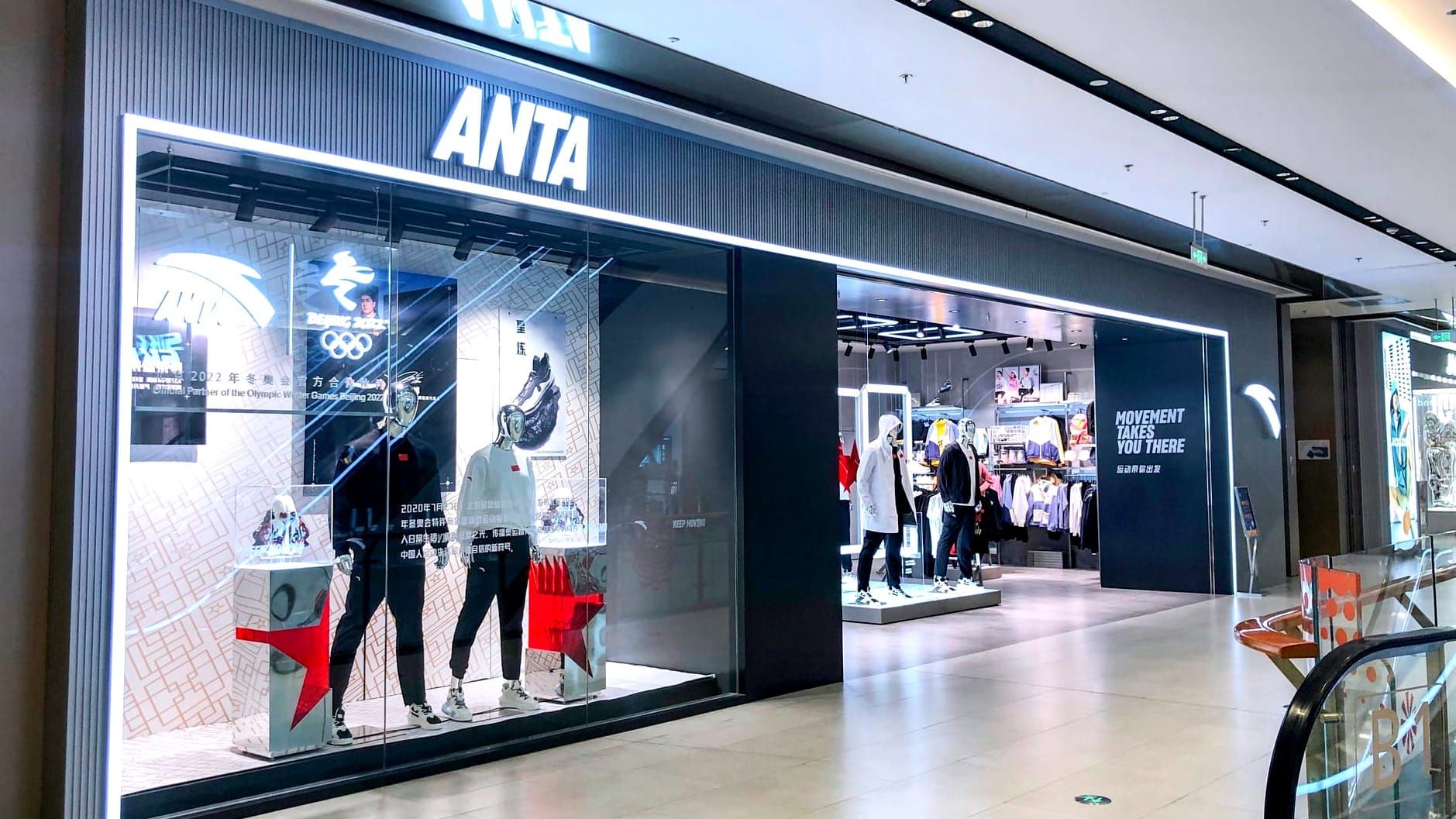
ANTA sells mostly through stores it controls rather than through wholesalers, and online sales reached 35.8% of revenue in 2025 across a base of roughly 12,900 stores.8
The group describes its own strategy as "Single-focus, Multi-brand, Globalization." The business is best understood as a shared operating platform, distribution, retail execution, supply chain and capital, applied selectively across brands with very different identities.
Why This Business Exists
Chinese consumers spend far less on sportswear per head than their peers in developed markets, and for most of ANTA's life that gap has been the opportunity. The company was founded in 1991 in Jinjiang, Fujian, as a maker of affordable shoes for a market that international brands served thinly and expensively. Value for money was the original promise, and a distribution network that reached more than 2,000 stores by 1997 turned that promise into early scale.9
The more interesting decision came later. Recognising that the ANTA brand alone could not reach the premium consumer, the company bought the China rights to FILA in 2009 and rebuilt it into a sports-fashion leader.10 That single act reframed the business. ANTA was no longer a value footwear maker hoping to trade up. It became a company whose core skill is acquiring or licensing a brand and running it better inside China than its previous owner could. Amer Sports, bought through a consortium in 2019 and floated in New York in early 2024, extended the same idea to a global portfolio.11
The structural question the business now answers is not whether Chinese sportswear demand will grow. It is who organises that demand across price points. ANTA's wager is that a single disciplined operator, running many brands from mass to premium, captures more of a maturing market than any single-brand competitor can.
How It Succeeds
The advantage rests on three sources that reinforce one another.
Join free to access the complete First Principles Brief.