A person owns something valuable, a gold chain, a wedding ring, a branded watch, and needs cash the object cannot directly provide. MoneyMax stands at that gap. It will lend against the item and hold it as security, or buy it outright, and it will also sell such items to someone else.
The One-Liner
MoneyMax turns illiquid personal wealth into cash. It lends against gold, watches, and jewellery, then resells the same goods across more than a hundred shops in Singapore and Malaysia.
FY2025 was the best year in its history, revenue up 39 per cent and profit up more than 80 per cent. How much of that record is the business, and how much is the gold price?
Walking through Singapore's heartlands sometimes reminds me of my years living in Manila. Many of the shops are similar. Supermarkets, bakeries, department stores, pharmacies. But one type of business was oddly familiar. The pawnshop.
In Manila, I associated pawnshops with less prominent districts, or with the streets near casinos. So I was surprised by how visible and established they were across Singapore's heartlands, in a city I otherwise thought of as highly modern and financially developed.
For a long time I held a simple view of what a pawnshop was. It existed for people who needed to exchange jewellery for immediate cash. Over time, I began to see there was more to it.
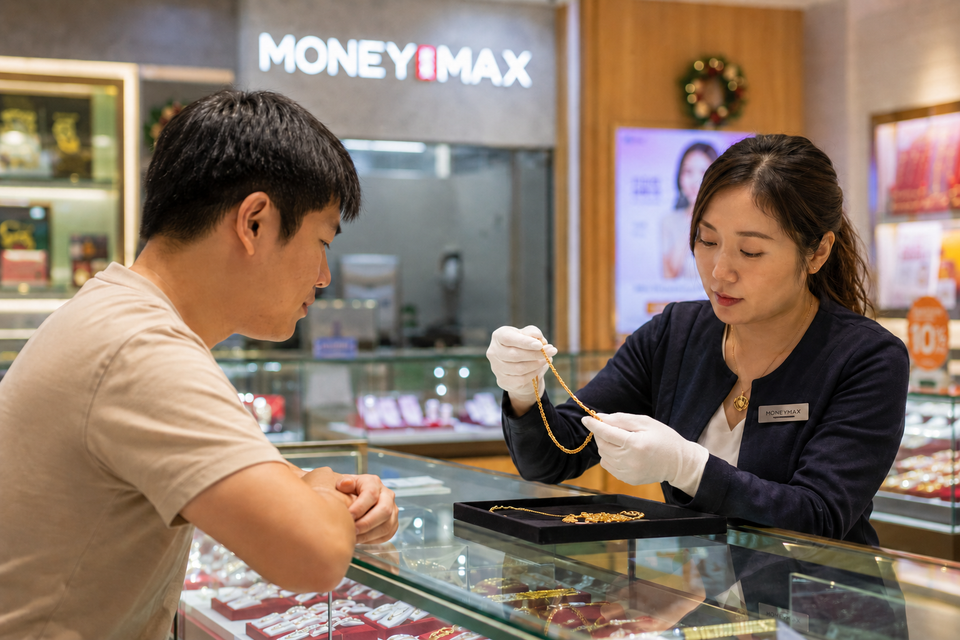
Shops such as MoneyMax were no longer only lending against gold jewellery. Their windows increasingly displayed branded watches, luxury bags, and pre-owned jewellery for sale. The more I noticed them, the more I saw that this was not simply a business of lending against valuables. It was also a business of valuation, liquidity, inventory, and resale.
That curiosity led me to MoneyMax as a listed company. What I found was a business that can earn from the same physical asset in several ways. It can lend against it, buy it, hold it, and in the end sell it. MoneyMax had taken an old trade and built a broader financial and retail business around it.
What remained to be understood was how much of its recent success came from the strength of that model, and how much came from the rising price of gold.
What This Business Actually Is
MoneyMax Financial Services is listed on the Singapore Exchange under the ticker 5WJ, first listed on the Catalist board in 2013 and transferred to the Mainboard in May 2026.1
It solves a narrow, durable problem. A person owns something valuable, a gold chain, a wedding ring, a branded watch, and needs cash the object cannot directly provide. MoneyMax stands at that gap. It will lend against the item and hold it as security, or buy it outright, and it will also sell such items to someone else.
Describing it as a pawnshop is accurate but incomplete. The business sits where several activities meet, collateralised lending, asset valuation, liquidity provision, and the trading and resale of gold and pre-owned luxury goods. Its core skill is pricing a physical object quickly and correctly, then choosing whether that object is better used as loan security or as inventory to sell.
The reported accounts split into four segments. Retail and Trading of Gold and Luxury Items is the largest by revenue, at about 78 per cent of the FY2025 total. Pawnbroking follows at about 18 per cent, and Secured Lending at about 5 per cent. A fourth segment, Others, is the group's investment-holding and support layer, and also covers auction and general insurance.2 The revenue order understates pawnbroking, which contributes a much larger share of segment results before finance costs than its share of revenue suggests. The balance between the two main businesses, retail and pawnbroking, is the central question about how MoneyMax makes its money.
Beyond the two main businesses, a smaller secured-lending arm extends vehicle financing and other asset-backed loans, where a borrower's circumstances matter alongside the collateral.3 MoneyMax operated 113 outlets across Singapore and Malaysia at the end of 2025, up from 105 a year earlier, with 51 in Singapore and 62 in Malaysia.4 Singapore still produces most of the money, about 86 per cent of revenue, while Malaysia now holds more stores and is growing faster.5
Why This Business Exists
A bank lends against your future. It weighs income, credit history, and the promise of repayment, and it takes time to decide. It will not, in an afternoon, turn the gold ring in a drawer into money. That gap is the problem MoneyMax exists to close. Valuable objects are not automatically spendable, and value and liquidity are not the same thing.
In pawnbroking, the collateral does most of the underwriting. A customer who needs cash quickly, has no credit record, or simply prefers not to borrow against income, can convert a physical asset into money in minutes, then redeem it later or let it go. This is one of the oldest financial services there is, and in Singapore and Malaysia it remains a licensed, regulated, and widely used part of everyday consumer finance.
The company was founded on 9 October 2008 by brothers Lim Yong Guan and Lim Yong Sheng, opening its first store in Yishun, and it listed on the SGX Catalist board in 2013.6 The founders treated an old trade as a retail format, with branded, brightly lit stores, standardised pricing, and a second business selling the goods that lending against valuables naturally puts in a broker's hands. An unredeemed pledge can become saleable inventory rather than an unsecured credit loss, provided the collateral was valued conservatively and can be realised at an adequate price. MoneyMax reports the sale of gold, luxury items, and unredeemed pledges as a single revenue line worth S$420.1 million in FY2025.7
The demand is durable because it does not depend on hard times alone. Gold and jewellery function at once as consumption, as a store of value, as inheritance, and as an emergency source of cash. When household finances tighten, people pledge. When gold rises, people sell, and the goods already held are worth more.
The business exists at the point where portable value meets ready cash, and it earns on the movement in both directions.
How It Succeeds
MoneyMax's economics appear to come from four connected sources. Whether they add up to a durable advantage is a question the evidence has to answer, not an assumption to start from.
Continue reading with a free account.
Join free to access the complete First Principles Brief.
You might also like
Oct 01
Trip.com Group Limited (TCOM): First Principles Analysis
Trip.com works as a system, not a single feature. Three ordinary advantages, inventory depth, loyalty and fulfilment, and the stakes in nearby platforms, interlock into something a single-point competitor cannot copy.
39 min read
Sep 19
VICOM: When Durability Matters More Than Growth
An economy cannot let vehicle owners certify that their own cars are roadworthy. Someone independent and accredited has to check, and Singapore makes that check compulsory through the LTA. VICOM was established in 1981 to provide it.
21 min read
Sep 01
Sheng Siong Group Ltd (SGX. OV8): First Principles Analysis
This analysis settles that tension with a sharper claim. Sheng Siong's advantage is durable enough to protect its existing economics but not expansive enough to justify any price. Its strength is persistence, not acceleration.
38 min read
Sep 01
ANTA Sports: The Machine Behind the Brands
ANTA built China’s largest sportswear group by making brands economically stronger through retail execution. Its next test is whether that machine can keep compounding as the brands and investments become larger, more expensive and harder to control.
26 min read
Jul 27
Digital Core REIT: When Digital Becomes Physical
The economic value of what the REIT owns is not ordinary floor space. It owns secured electrical capacity, cooling infrastructure, network connectivity, physical security and resilient building systems, located in markets where new supply is constrained.