When Information Becomes Abundant, Judgment Becomes Scarce
AI can model the odds. It cannot be the one who decides to proceed despite them.
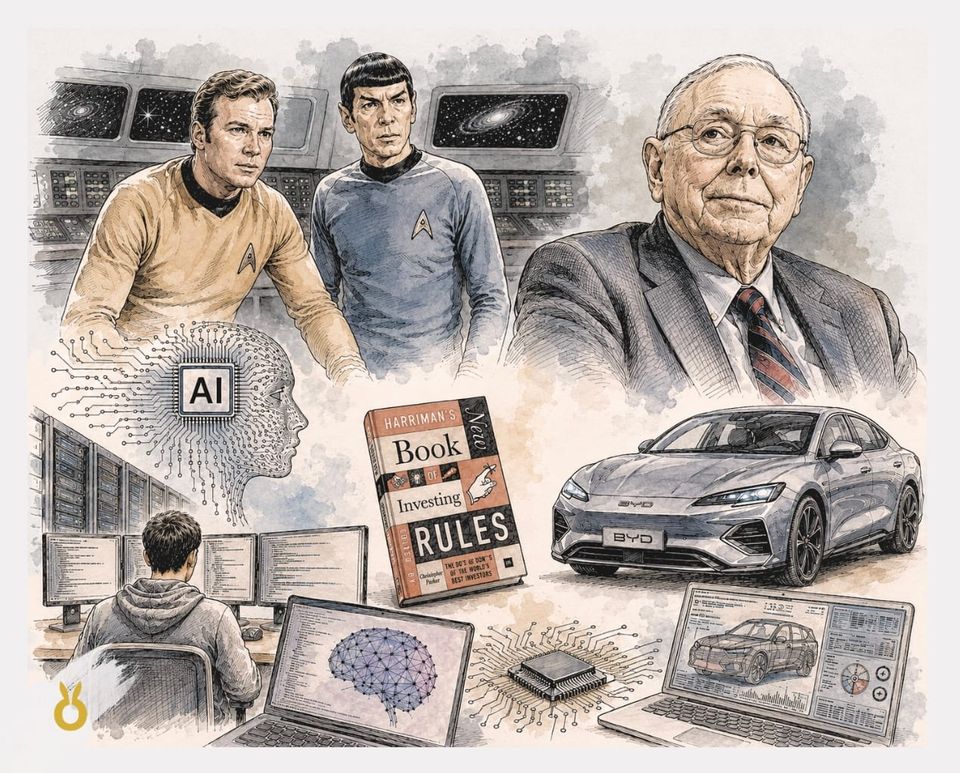
That, of course, is fiction. But good storytelling reflects something real. And the pattern it describes, reframing the question rather than refining the calculation, shows up in places that matter considerably more than a starship bridge.
In 2008, Charlie Munger pushed Berkshire Hathaway to invest approximately $230 million in BYD, a company most investors in the West had never heard of.1 The conventional metrics were unspectacular. BYD was a mid-sized Chinese battery manufacturer entering an electric vehicle industry that was capital-intensive, fiercely competitive, and unproven at scale. By most standard assessments, the odds were not favourable.2
Munger did not dispute the metrics. He reframed the question.
Instead of asking whether the industry would succeed, he asked who was best positioned to make it succeed. The answer, in his judgment, was Wang Chuanfu. Munger described Wang as a combination of Thomas Edison and Jack Welch.3 A builder and an operator in the same person. Someone who could conceive the thing and then actually make it. The investment, in Munger's own framing, was a bet on the horseman rather than on the horse.4
Berkshire eventually made around $7 billion on that position. Roughly thirty times the original investment.5 Munger later called it the best thing he ever did at Berkshire.
The data was available to anyone. The annual reports, the industry analysis, the competitive landscape. What was not available was the insight to ask a different question. It was not whether the numbers justify entry, but whether the person running the business is the kind of person who makes the numbers irrelevant over time.
That question does not come from a model. It comes from a mind that has spent decades learning what actually determines outcomes, and is willing to weight that above what the spreadsheet says.
Consider a book that sits on many serious investors' shelves: Harriman's New Book of Investing Rules, a collection of frameworks, principles, and hard-won convictions from some of the most successful investors of their generation.6
Read it carefully and something becomes apparent almost immediately.
The contributors contradict each other.
Not on minor points. On fundamental ones. One investor swears by concentration. Another by diversification. One buys only what is measurably cheap. Another pays a premium for quality and holds indefinitely. One treats technical signals as essential inputs. Another dismisses them entirely. Each position is held with conviction. Each is supported by a track record that commands respect.
Now imagine feeding the entire book to an AI.
It would read every chapter. Extract every principle. Identify every area of agreement and every point of conflict. It would produce, on request, a thorough synthesis: here is what the majority believe, here are the outliers, here are the conditions under which each approach has historically worked.
That synthesis would be useful. It would save hours. It would surface connections a single reading might miss.
But it would not tell you which investor to follow. It could not. Because the contradictions in that book are not errors to be resolved. They are the product of different minds, different experiences, different market environments, and different temperaments applied to the same fundamental problem over decades.
That is not something the book can give you. It is not something AI can extract from the book on your behalf.
The information is all there. Deciding which investor to listen to, and when, and why, and with what adjustments for your own situation remains entirely yours.
This is worth being precise about, because the common framing misses what matters most.
AI can produce something that looks very much like judgment. Feed it a problem and it will structure the considerations, weigh the evidence, identify the risks, and arrive at a conclusion. The output is often fluent, internally consistent, and well-organised.
But it is bounded in a specific way. At its core, it is a sophisticated version of what Spock does. It takes the available data and applies a consistent framework. The result is the most defensible conclusion the question allows.
What it cannot replicate is what sits outside that sequence.
That includes the pattern recognition that develops after years of being wrong in similar situations. It includes the instinct that something is off even before the evidence confirms it. It includes the ability to question the framework itself.
And occasionally, it includes something harder to name. An insight that arrives not from calculation, but from having lived through enough decisions to recognise their shape.
Call it experience. Call it intuition. Call it, if you are being honest about how often it shows up uninvited, luck.
None of these are irrational. They are forms of knowing that do not fit neatly into a logical sequence.
And here is the part that matters most. Even if AI could synthesise all of that, the decision itself would still not belong to it. Because the act of taking on risk is not a calculation. It is a commitment. It requires someone who will live with the consequence, who has something at stake, who is accountable to the outcome.
AI can model the odds. It cannot be the one who decides to proceed despite them.
AI does not just compress the low-value work. It also produces outputs that look like the high-value work.
A well-structured synthesis. A confident summary of the key risks. A clean set of conclusions with supporting evidence arranged beneath them. These outputs have the shape of analytical judgment. They are organised, fluent, and internally consistent.
But shape is not the same as substance.
The danger is not using AI. It is accepting the first structure it provides.
A conclusion that arrives pre-organised takes less effort to absorb. That ease is not neutral. It suppresses the instinct to push back, to ask what is missing, to sit with genuine uncertainty. The analyst who spent three days working through a difficult filing is acutely aware of what they do not know. The analyst who received a clean summary in twenty minutes may not be.
Confidence is not accuracy. But they can feel identical.
The substitution problem has a companion, and it is less visible.
AI answers questions very well. It is structurally less useful for identifying which questions should have been asked. And it almost never asks what happens if the question itself is wrong.
Most serious analytical errors are not errors of calculation. They are errors of framing. The analyst asked a precise question and received a precise answer, but the question itself was wrong. The same way Spock's calculation was precise, logical, and built on an incomplete frame.
Consider the difference between asking what the return on equity is, and asking why it is high and what would make it disappear. The first produces a number. The second produces an understanding of the business. Both require the same data. Only one requires judgment about what actually matters.
The important questions rarely announce themselves. They emerge from sitting with a problem long enough to understand what is actually being asked. Sometimes they arrive by inversion: not what makes this work, but what would make this fail. Not what the odds of success are, but what the cost of not trying looks like.
That process is slow. It produces nothing visible for a while. It looks, from the outside, like not working.
The risk is specific. If a tool consistently provides a ready-made frame before the analyst has decided what they are actually trying to understand, the practice of formulating the right question gets skipped. Not eliminated. Skipped. Regularly enough that it weakens.
We adopt tools to free up time for higher-order thinking. The capability most at risk is the one that higher-order thinking depends on.
This is not a story about AI. It is a story about where human advantage migrates when technology removes old sources of it.
Before organized financial data, the edge was access. Once access was democratized, it migrated toward the ability to process and organise. Once processing became automated, it migrated again. Toward framing. Toward calibrating uncertainty. Toward deciding when the evidence is sufficient and when it is not. Toward knowing which question to ask before the tools are even opened.
Each migration follows the same logic. The technology handles what it can handle. What remains is the part that requires a human being with a developed mind, a considered view about how the world works, and the willingness to invert the question when the obvious frame is leading somewhere incomplete.
Two analysts. Same company. Same documents. Same tools. Different conclusions.
The difference is not the data. It was never the data.
The analyst who has continued to develop genuine judgment does not lose the edge when information becomes abundant. They have practiced framing hard questions and learned to distinguish a real conclusion from a fluent imitation of one. The edge compounds. Precisely because it is no longer bundled with cheaper activities that once obscured it.
Information tells you what is happening. Judgment helps you decide what to do about it.
It begins with the insight to ask a different question. It continues with examining the assumptions beneath the evidence. And it ends, as it always has, with a person willing to be accountable for the answer.
AI may reduce the cost of analysis. It may even reduce the cost of expertise, in the narrow sense of knowing facts.
When information is available to everyone, it ceases to be the source of the edge.
Judgment remains.
Because judgment is what survives after
information becomes abundant.
Follow new research, company updates and analytical perspectives from Glavcot Insights. If you don’t see the confirmation email, check your spam folder.