Haidilao's service quality did not emerge from a training manual. It was built through a specific mechanism: a master-apprentice incentive structure where store managers are compensated not just on their own store's performance, but on the performance of managers they trained
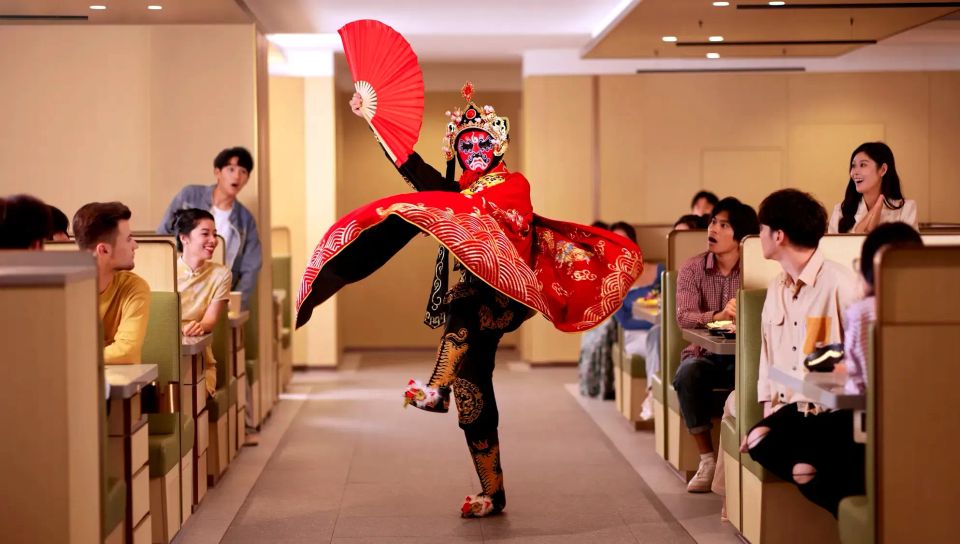
A traditional face-changing performance in one of Haidilao's hotpot restaurants.
The One-Liner
Haidilao built a restaurant operating system around one idea: that service, delivered consistently at scale, creates its own economics. The question is whether that system still compounds when expansion slows.
A note before this brief
Everyone is looking at AI right now. The questions are real and the stakes are significant. But one discipline of good research is knowing when to look away from the crowded field.
My instinct when narrowing down candidates is not just to find good metrics. Good metrics are the baseline, not the edge. The question is where genuine analytical gaps exist: businesses that are visible, covered, even well-known, but where the right question is not being asked clearly.
That led me to the food sector. Restaurants are everywhere. The stocks are listed. But the analytical attention is elsewhere.
The specific trigger was unexpected. I was watching a documentary on Singapore's Good Class Bungalows and one name appeared that I recognised: Zhang Yong, founder of Haidilao, now a naturalised Singaporean citizen.1 He purchased a S$27 million bungalow on Gallop Road in 2016, known as The Winged House.2 A man who started with a handful of hotpot tables in Sichuan and built one of China's largest restaurant chains. That story, and the business behind it, deserved a closer look.
This is that look.
I have dined at Haidilao a few times. What stayed with me was not the hotpot itself. It was the surrounding architecture of the experience. While waiting for a table, I noticed people queuing for a complimentary manicure. Free snacks arrived without asking. There was a designated play area for children, staffed and stocked with toys, so parents could actually sit and wait without managing restless kids.3 Inside, everything felt considered: the setting, the presentation of the food, the attentiveness of the staff. At some point during the meal, someone performed a noodle dance at the table. Staff smiled consistently and moved through the space as though the entire room was their personal responsibility.
All of that, though, was before COVID.
I do not know what the experience is like now. What I do know is that the queue at VivoCity on weekends suggests the brand still pulls. Whether the service that built that queue is still what it was is a different question entirely.
Haidilao is not under-covered. The common read is a recovery thesis: table turnover improving, franchise optionality building, China consumer sentiment normalising. That framing may be correct. But it is not the right first question. The right first question is what kind of business Haidilao actually is, and whether the thing that made it famous still creates the economics.
What This Business Actually Is
Haidilao International Holding Ltd is listed on the Hong Kong Stock Exchange under stock code 6862, commonly shown as 6862.HK
Zhang Yong founded Haidilao in 1994 from a four-table store in Sichuan.4 The concept was not differentiated hotpot. It was not cheaper hotpot. It was the same hotpot, served better, every time, at every table. That discipline of execution, not product, became the brand.
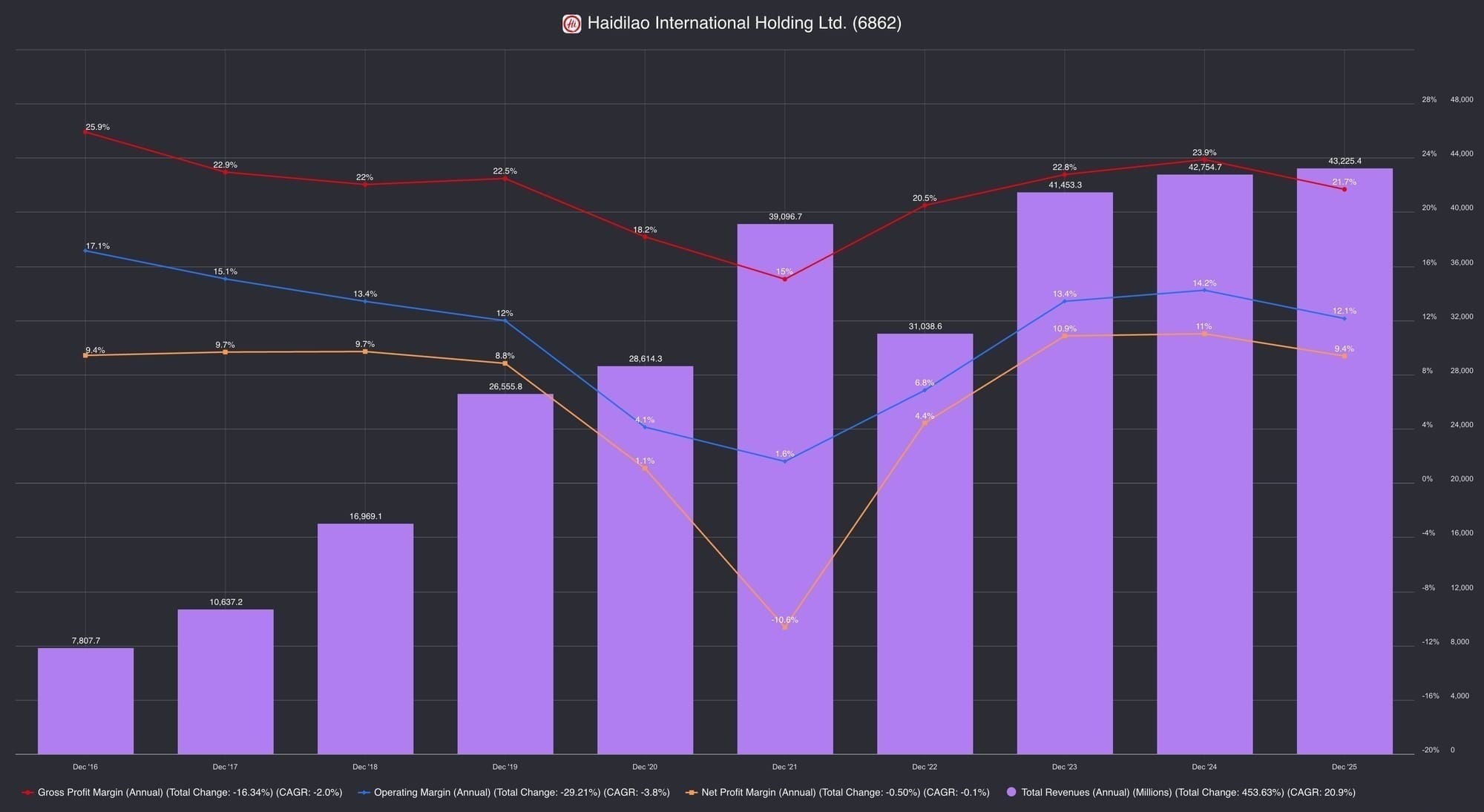
Thirty years later, Haidilao operates 1,304 company-owned and 79 franchised restaurants across Greater China.5 Group revenue exceeded RMB 43 billion in FY2025. It remains one of China’s largest and most recognisable hotpot chains, with over 200 million registered members and an average guest spend of RMB 97.7, at the expensive end of the casual dining spectrum, in an environment where Chinese consumers have been aggressively trading down.6
Revenue in FY2025 broke into three streams: core dine-in at RMB 39 billion, delivery at RMB 2.66 billion (up 112% year-on-year), and a portfolio of twenty sub-brands under the Red Pomegranate Plan at RMB 1.52 billion. 8 Total group revenue grew 1.1%. Look at what drove that.
In early 2024, management opened the brand to selective franchising for the first time in its thirty-year history. By end of FY2025, 79 franchise locations were operating.5 The question that framing raises but does not answer: is franchising a genuine second-growth mechanism, or a capital-light acknowledgment that the self-operated model has reached its ceiling? That is the next layer of work.
Gross, operating, and net margins have compressed steadily since 2016. Revenue has grown. The economics of delivering that growth have not kept pace.
Why the Business Exists
Casual dining in China has historically been one of the most fragmented and operationally unstable sectors in the economy. Before standardised national chains, dining out was plagued by three chronic consumer problems: inconsistent food safety, unpredictable quality across locations, and transactional, indifferent service.
Haidilao exists because it solved all three at scale. The supply chain does the first two. Yihai International handles soup bases and seasonings. Shuhai manages cold-chain logistics and centralised prep. Both entities are connected to Zhang Yong's network. Together, they give Haidilao more supply chain control than most restaurant operators at any scale can replicate.7 Ingredients arrive to spec, every time, at every location. The customer never wonders whether the broth is safe.
The format solves a structural problem most restaurant chains cannot. Hotpot requires no skilled back-of-house chef: the customer cooks the food at the table. This removes the single largest source of quality inconsistency in the restaurant category. The kitchen is a prep and supply function, not a production one. One fewer variable, held constant, across 1,300 locations.
The third problem: indifferent service, is what Haidilao made its identity. Not by training staff harder than competitors, but by building a system that made attentiveness financially rewarding at the store level. The business exists because it turned service from a hospitality value into an operating mechanism. That is unusual. And it explains why customers who have eaten there once tend to come back.
How It Succeeds
Haidilao's service quality did not emerge from a training manual. It was built through a specific mechanism: a master-apprentice incentive structure where store managers are compensated not just on their own store's performance, but on the performance of managers they trained and mentored into opening their own stores.9 The royalty flows down the lineage. A great manager is financially rewarded every time someone they mentored succeeds.
This is an unusual design. It creates ownership-level accountability at the store floor, not just at the corporate level. It explains how service standards propagated across hundreds of locations without a bureaucratic enforcement layer. The culture spread because people were directly paid for spreading it correctly.
But this mechanism has a condition. It requires expansion. New stores, new apprentices, new royalty events. In a growing network, the incentive structure fires continuously. In a mature or contracting one, the lineage stops extending. What remains is culture. Culture without the incentive engine that produced it becomes something different. Maintenance, not compounding.
The FY2025 network tells that story. Self-operated store count fell from 1,355 to 1,304.10 Total table turnover dropped from 4.1x per day in FY2024 to 3.9x in FY2025. Revenue from self-operated Haidilao brand locations fell 7.1%, from RMB 40.4 billion to RMB 37.5 billion. Total restaurant operations including sub-brands and franchises declined 4.5%. The gap between the two numbers tells you where the core pressure sits.11
Continue reading with a free account.
Join free to access the complete First Principles Brief.
You might also like
Sep 19
VICOM: When Durability Matters More Than Growth
An economy cannot let vehicle owners certify that their own cars are roadworthy. Someone independent and accredited has to check, and Singapore makes that check compulsory through the LTA. VICOM was established in 1981 to provide it.
21 min read
Sep 01
ANTA Sports: The Machine Behind the Brands
ANTA built China’s largest sportswear group by making brands economically stronger through retail execution. Its next test is whether that machine can keep compounding as the brands and investments become larger, more expensive and harder to control.
26 min read
Aug 01
MoneyMax: Where Gold Meets Liquidity
A person owns something valuable, a gold chain, a wedding ring, a branded watch, and needs cash the object cannot directly provide. MoneyMax stands at that gap. It will lend against the item and hold it as security, or buy it outright, and it will also sell such items to someone else.
19 min read
Jul 27
Digital Core REIT: When Digital Becomes Physical
The economic value of what the REIT owns is not ordinary floor space. It owns secured electrical capacity, cooling infrastructure, network connectivity, physical security and resilient building systems, located in markets where new supply is constrained.
14 min read
Jul 15
Trip.com: Is Travel Still the Product, or Is the Platform the Asset?
The business itself made intuitive sense. Travel is not a fad. People still want to move, explore, visit family, take holidays, and experience places beyond where they live. The form of travel may change. The human desire behind it is unlikely to disappear.