Zijin Mining Group (2899.HK): First Principles Analysis
State-backed capital funds entry into difficult jurisdictions. Difficult ore is precisely what Zijin's process edge was built to solve. The returns then reinforce the balance sheet that helps keep capital cheap. Remove any one component and the others weaken.
If you're coming from the First Principles Brief, you already know what Zijin does and why the business exists. This is where the analysis deepens.
The Brief ended on an open question and five specific tests. It argued that Zijin's advantages and its discount come from the same place, that difficulty is the business model rather than an obstacle to it, but that the evidence could not yet settle whether the market is correctly pricing the difficulty or misreading it.
What follows takes the moat apart component by component, then tests the ways the Brief said the model could fail, against evidence the Brief did not fully use: the FY2025 annual report, the segment accounts, the reserve and unit-cost disclosures, the 2025 AGM voting record, and the July 2026 half-year guidance. Some of that evidence sharpens the bull case, and the first-half 2026 numbers sharpen it hard.
One part of it, the gap between what Zijin earns and what reaches the minority owner, is now measurable, and it is smaller and steadier than the structure alone would suggest.
Before going further, it helps to see what Zijin actually controls. Zijin is commonly described as a miner. Mining is only one part of its operating system.
Integrated Model
Zijin Mining
Mining
Processing and Concentrates
Smelting
Refining
Sale of Refined Products
Cash Flow Across Multiple Layers
Zijin participates across more of the value chain, retaining economics that would otherwise sit beyond the mine itself.
Simplified Model
Other Miners
Mining
Processing and Concentrates
Sale of Concentrates
Cash Flow from Extraction
Some miners focus primarily on extracting resources and realise most of their economics before the later processing stages.
Zijin does not simply extract ore and sell it. How much metal it produces matters. How much of the value chain it retains matters too.
Pillar I (The Moat): What Difficulty Keeps In and Competitors Out
Zijin's edge is not a lucky deposit or a high price. It is one capability repeated, turning difficulty into economics, across three components: difficult ore, difficult jurisdictions, and difficult capital. Each is an advantage and a point of failure at once. We take them in turn, judging how durable each is and where it stops.
The 3 Key Components
The process edge on difficult ore
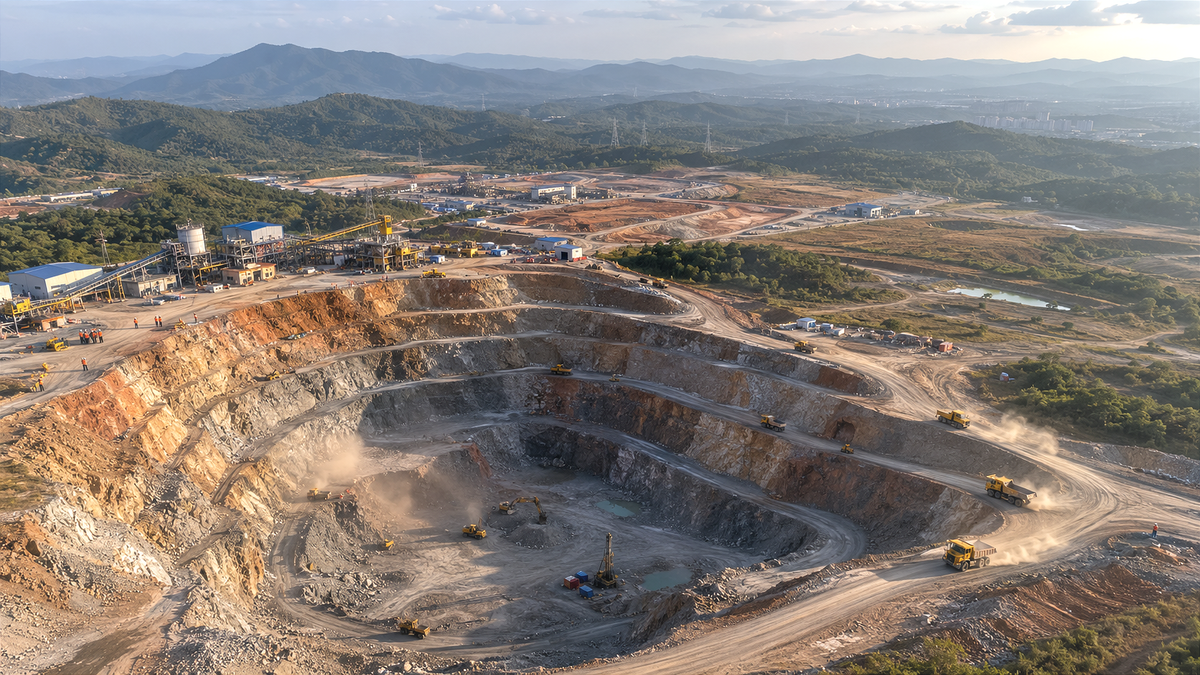
Zijin's origin mine, Zijinshan, was considered uneconomic at inception, too low-grade and metallurgically complex to work.1 The company survived by learning to recover metal others had written off, using hydrometallurgical methods like bio-leaching and pressure oxidation.2 Think of the machine and the medium. The processing technique is the machine and Zijin's edge. The rock is the medium and the constraint. Every acquisition bets not that the price will rise, but that Zijin's engineers can make the same rock worth more than anyone else can.
The FY2025 costs bear this out. Unit cost of sales was RMB 22,362 per tonne of copper concentrate and RMB 334 per gram of mined gold, low for ore this complex.3 That is a controlled internal cost profile rather than a proven position on the global cost curve, which would need a like-for-like peer comparison, but it is a favourable one. Captive smelting adds to it. Owning its own smelting and refining keeps more of the processing economics inside the group.4 That does not erase the tension between mining and smelting margins, but it captures more of the chain and more control over where the margin sits.
The boundary is the medium, not the machine. The edge has held orebody after orebody in copper and gold, but lithium brine is a different chemistry, and nothing in the record proves the machine transfers, least of all into a weak lithium price.5 Whether the edge is general or specific to hard rock is the one thing this component cannot yet settle.
The frontier position others will not take
The easiest mining jurisdictions are crowded, expensive, and slow. The best undeveloped deposits often sit where political, fiscal, or social risk is too uncomfortable for Western majors, who answer to stricter capital discipline, heavier ESG scrutiny, and shareholders who prefer buybacks to frontier development.6 Zijin moves into the DRC, Serbia, Colombia, Suriname, Central Asia, and Argentina because the risks that repel others show up as an acquisition discount, and it assembled Kamoa-Kakula, Julong, Cukaru Peki, Kolwezi, and gold across four continents on that logic.78
Two things make this more than a taste for risk. Speed, because the industry usually needs ten to fifteen years to move a discovery to production and Zijin compresses that to two or three, earning more on the same geology since time is the biggest lever on a mine's value.9 And scale, because operating across more than 30 projects in 19 countries spreads fixed cost thin enough to hold cash flow when prices fall.10
The boundary is the same fact that creates the edge. A jurisdiction discounted for tax revision, resource nationalism, or sanctions can reprice at any time, and once the capital is sunk the discount becomes a loss. This is a moat only in that few competitors will cross it, and that willingness stays rational only while host governments let Zijin keep the economics.
State-backed capital as a cost advantage
The first two components cost money, and the third funds them. Zijin's state anchor, through the Shanghang County ownership set out in Pillar II, gives it patient financing and a lower cost of debt than a private frontier miner would get.11 Where a project's value is so sensitive to the discount rate, a structurally lower cost of capital is itself an advantage. The recent Chifeng consolidation was funded partly by zero-coupon convertibles due 2031 and an earlier one-percent convertible due 2029, and across a RMB 164.9 billion borrowing book rates run from as low as 0.67%.12 Two cautions keep this honest. A convertible's low coupon is paid partly in equity-option value, so it understates the true cost, and 0.67% is the floor rather than the average, which the FY2025 finance costs put nearer 1.3%. What the financing does show is unusual access. Zijin raises flexible, low-coupon capital at a scale a standalone frontier miner could not, and state affiliation is the most plausible reason creditors extend it, even if the exact size of that advantage cannot be isolated. That access turns the first two components into a repeatable acquisition machine rather than a one-off run of good deals.
The boundary is that the same structure is the governance question, which Pillar II takes up. This is the least replicable component, because a competitor can license a process or take a jurisdictional risk far more easily than it can acquire a sovereign's balance sheet. The advantage is real. Whether it serves the minority owner is the question the rest of this analysis keeps returning to.
Do the three components interlock?
They do. State-backed capital funds entry into difficult jurisdictions. Difficult ore is precisely what Zijin's process edge was built to solve. The returns then reinforce the balance sheet that helps keep capital cheap. Remove any one component and the others weaken.
The three components interlock. Whether they are equally durable is another matter.
Access the complete analysis.
First Principles Analyses and Research Snapshots are included with Full Research Access.
You might also like
Oct 01
Trip.com Group Limited (TCOM): First Principles Analysis
Trip.com works as a system, not a single feature. Three ordinary advantages, inventory depth, loyalty and fulfilment, and the stakes in nearby platforms, interlock into something a single-point competitor cannot copy.
39 min read
Sep 01
Sheng Siong Group Ltd (SGX. OV8): First Principles Analysis
This analysis settles that tension with a sharper claim. Sheng Siong's advantage is durable enough to protect its existing economics but not expansive enough to justify any price. Its strength is persistence, not acceleration.
38 min read
Jul 19
Zijin Mining Group: Snapshot
The Snapshot distills the full First Principles Analysis into a single reference page: the central question the analysis is built
12 min read
Jul 01
Pan-United Corporation Ltd. (P52.SI): First Principles Analysis
If you're coming from the First Principles Brief, you already know what Pan-United does and why the
31 min read
Jun 21
Zijin Mining Group: Finding Advantage in Difficult Ground
At the surface level, Zijin exists to resolve a physical supply deficit. Decarbonisation, electric vehicles, solar and wind, transmission grids, and the computing infrastructure behind AI all require more copper at a time when the global mining sector has been starved of new supply.