
If you're coming from the First Principles Brief, you already know what Haidilao does and why the business exists. This is where the analysis deepens.
The question this FPA works through is not whether Haidilao is a good or bad business. It is whether the system that produced thirty years of compounding still produces it from here, or whether the conditions that made the system work have moved on. That question runs through all three pillars: a moat that depends on continued network expansion, a steward who is also the risk, and an engine producing exceptional but visibly fading returns.
Check out the First Principles Brief here:
Haidilao (6862.HK): Is Service the Moat, or the Cost?
Haidilao’s service quality did not emerge from a training manual. It was built through a specific mechanism: a master-apprentice incentive structure where store managers are compensated not just on their own store’s performance, but on the performance of managers they trained
 Ryan Gallinera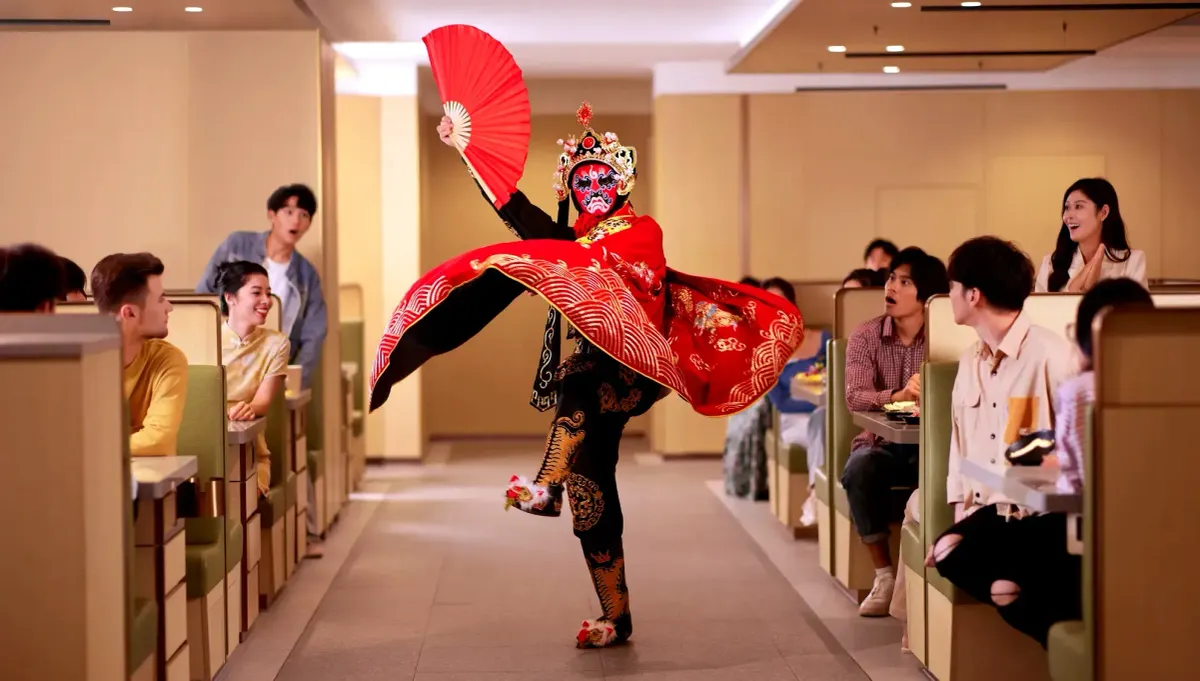
Pillar I: The Moat: What keeps customers in and competitors out
Restaurants are a hard place to build a moat. Low gross margins, high fixed costs, no proprietary technology, shifting taste, and a customer who can switch venues without friction. Most restaurant brands do not have moats. They have habits, location, and price. When any of those slip, the customer leaves.
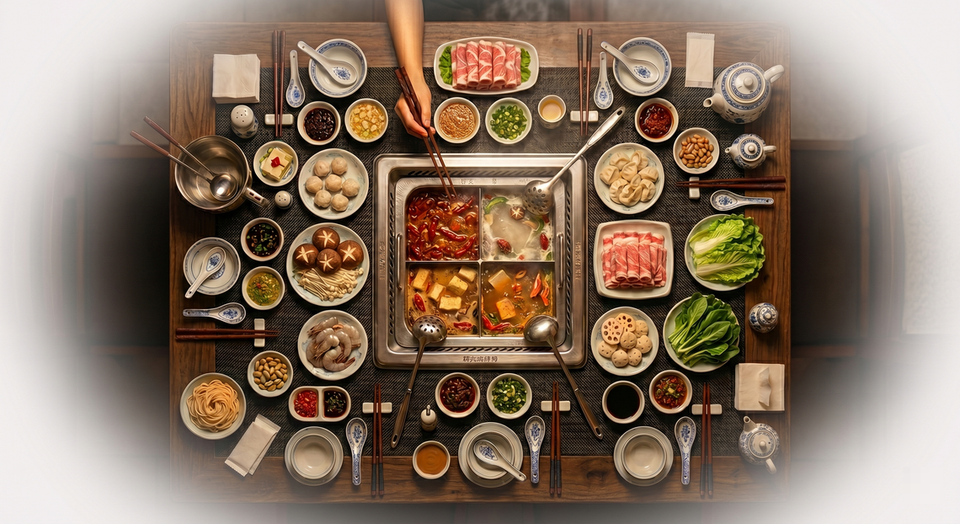
Haidilao is different. The moat is not in the hotpot itself. It is in the system that delivers the hotpot, table after table, across thousands of locations, for thirty years. That system has four interlocking components.
The master-apprentice incentive structure as institutional design
The master-apprentice royalty made enforcement self-organising. 1 That design has a name. Haidilao is the textbook case of the Amoeba philosophy, drawn from Kazuo Inamori's work at Kyocera. 2 Zhang Yong restructured the company between 2011 and 2015, stripped out middle management, and turned every store manager into a small business owner whose income grew every time someone they trained succeeded. The result was service quality at a scale no Western chain has reliably reproduced: pre-meal manicures, noodle dances at the table, a waiter who refilled your water glass before you noticed it was empty. None of it came from a training manual. It came from a system where every employee had a financial reason to make every customer feel individually seen. But the design has one condition: it requires expansion. When the network grows, the incentive fires. When it stalls, the lineage stops extending. In H1 2025, management attributed underperformance directly to "subpar customer service, which negatively affected repeat visits." 3 4 The mechanism was confirming itself in reverse. The design is brilliant. It is also conditional. Both things are now visible at once.
Vertical supply chain control via the Zhang Yong network
Haidilao's supply chain is not outsourced. Soup bases come from Yihai International, a separately listed company Zhang Yong controls. Cold-chain logistics, HR and training, store design and construction: each was once a division of Haidilao, spun off under the Amoeba restructuring, and each remains inside Zhang Yong's network. 5 6 The result is that ingredients arrive to spec, every time, at every location. In a market where food safety has been a chronic consumer anxiety for decades, that consistency is the moat behind the moat. The caveat is structural: investors in 6862.HK are buying the restaurant operating company. The soup base business, the logistics business, the trademark itself: those sit elsewhere in the Zhang Yong universe. That does not break the thesis. It does change what you own.
The format makes scale possible. Scale doesn't make competition disappear.
Hotpot has a structural advantage most analysts understate. There is no skilled back-of-house chef. The customer cooks at the table, which removes the single largest source of inconsistency in chain restaurant operations. Adding a thousandth store does not require finding a thousandth head chef. It requires finding a thousandth store manager, which is exactly what the master-apprentice system was built to produce. 7 The competitive picture is less comfortable. Korean BBQ, themed concepts, and fast-casual formats now compete for the same communal dining occasion that hotpot once owned. The threat is not another hotpot chain. It is everything else a group of friends could do with the same evening. Haidilao's brand premium is not protected by IP. It is protected only by the operating discipline of the system behind it. And that system requires expansion to compound. The competitive set is fragmenting at precisely the moment the apprentice mechanism is firing less frequently. The twenty sub-brands, the delivery push, the franchise opening: each is a response to that same observation. 8 9
Takeaway
The service-as-system playbook
Haidilao belongs to a small category of businesses that made service quality a durable advantage at scale. Not through training manuals or mystery shoppers, but through institutional design. Costco did it in retail. Singapore Airlines did it in aviation. The pattern is the same: the right behaviour becomes the default behaviour, because the system makes it the most economically rewarding one. Haidilao did that in casual dining. The master-apprentice royalty, the Amoeba restructure, the standardised supply chain: each was a layer of the same machine. At its peak, it was the most replicable form of unreplicable service in the restaurant industry.
Haidilao belongs to a small category of businesses that made service quality a durable advantage at scale. Not through training manuals or mystery shoppers, but through institutional design. Costco did it in retail. Singapore Airlines did it in aviation. The pattern is the same: the right behaviour becomes the default behaviour, because the system makes it the most economically rewarding one. Haidilao did that in casual dining. The master-apprentice royalty, the Amoeba restructure, the standardised supply chain: each was a layer of the same machine. At its peak, it was the most replicable form of unreplicable service in the restaurant industry.
The moat is real. But it operates within a boundary the company does not fully control. The boundary is expansion. When the network was growing, the incentive fired continuously. When it slowed, the system shifted from compounding to maintaining. Those are different operating modes, and the FY2025 numbers reflect exactly that shift.
The business is assessed. What comes next is the harder question: who is stewarding it, and does the founder's return reset the engine?
Access the complete analysis.
First Principles Analyses and Research Snapshots are included with Full Research Access.