"It is our job to make this look accidental, and it is our job to make this look effortless. I don't think of this as the pieces falling into place. You PUT the pieces where they are."
— Taylor Swift to her dancers and co-performers,The Eras Tour (Taylor's Version) documentary
That stopped me.
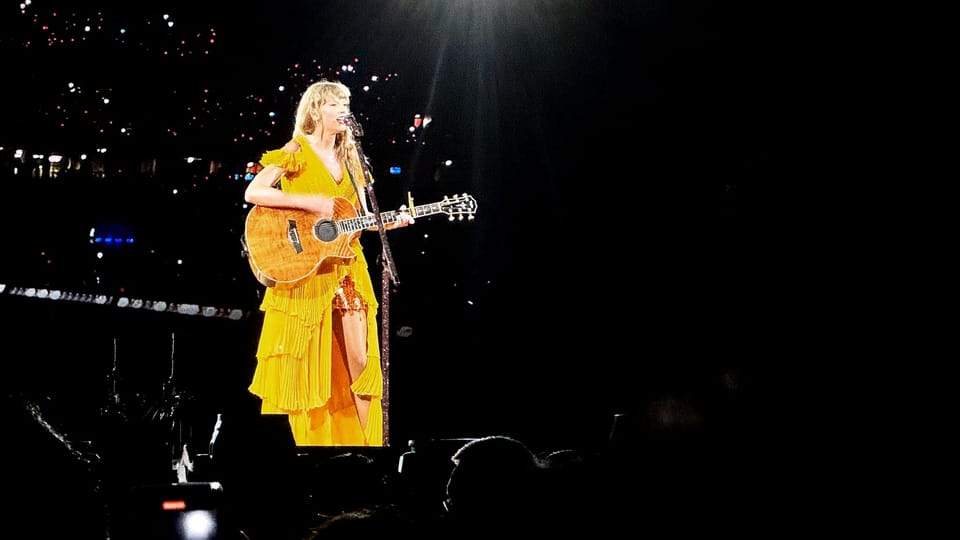
Taylor Swift performing at the Eras Tour, Singapore, March 2024
How relentless fan focus built a billion-dollar business moat
A Special First Principles Brief
This isn't about a stock you can buy. It's about demonstrating how the same frameworks we use to analyze businesses—Moat, Stewards, Engine—apply to any business, anywhere.
Consider this a case study in ownership thinking.
"Everyone talks about phenomenons like "The Eras Tour," almost as if it was pieces falling into place in some sort of accidental confluence of events that just happened, right?
... I don't think about it as pieces that fell into place. I think of each of you like tectonic plates on the earth that took millions of micro decisions and forces of you pushing and pushing inch by inch closer together. The Eras Tour wasn't when all the pieces fell into place. That was when every single one of us had done so much work.
It is our job to make this look accidental, and it is our job to make this look effortless. I don't think of this as the pieces falling into place. You PUT the pieces where they are."1
— Taylor Swift to her dancers and co-performers, The Eras Tour (Taylor's Version) documentary
That line stopped me.
Most entertainers talk about inspiration, passion, following your dreams. Swift’s talking about systematic decisions over decades.
That’s not simply an artist speaking. That’s a business owner commanding respect.
I’m not a Swiftie. Can’t name her albums. But when she re-recorded her entire catalog to reclaim the masters? That caught my attention, and admiration.
Most artists sue their labels. Swift just made theirs obsolete. Took years of work. Built a competing asset that destroyed the value of the original.
That’s not emotion. That’s better capital allocation than most CEOs.
Then I saw that quote, and it confirmed what the re-recording already showed: she can command respect because she takes ownership, not only as a performer.
So I asked: What if we analyzed Taylor Swift like a business?
Answer: A business most public companies would envy.
This isn’t about music. It’s about owner thinking in an industry that doesn’t usually work that way.
Let’s break it down.
First Principles Brief
The Pieces Didn't Fall Into Place
Most people watch Taylor Swift command a stadium of 70,000 fans and see magic. They see the confetti cannons, the costume changes, the three-hour performance without intermission. They see a cultural phenomenon.
What separates enduring businesses from lucky ones is simple: success isn't timing or talent alone. It's about knowing which pieces matter, putting them where they need to be, and doing the invisible work that makes visible excellence inevitable.
This is true whether you're running stadium tours or building semiconductor supply chains. Let's deconstruct how Swift built a business most public companies would envy.
WHAT IS THE BUSINESS?
Taylor Swift isn't a singer who happens to make money. She's a vertically integrated entertainment platform:
Intellectual Property Creation & Ownership
Writes or co-writes virtually all her music (publishing rights retained)2
Re-recording original albums to reclaim master ownership
Controls creative direction across all formats
Direct Distribution & Fan Relationship
The Eras Tour grossed over $2 billion, becoming the highest-grossing tour in history3
279 million Instagram followers — larger reach than most media companies4
Direct merchandise sales (owns the supply chain)
Strategic Brand Control
Concert film grossed $261 million globally — bypassing traditional studio distribution5
Partnerships that reinforce brand values, not cash extraction
Media narrative control through strategic access
Changed, midfield these parts also:
This isn’t a celebrity brand. This is a media conglomerate with one extraordinary CEO (Creative Director, Muscian, Singer…amongst many other things).
WHY DOES THE BUSINESS EXIST?
Here's where most artist businesses fail: they optimize for quarterly releases or label demands. Swift optimizes for fan lifetime value.
The Over-Serving Philosophy
Swift's own framing: her job (and in her own words) is to "over-serve" fans. Not meet expectations — exceed them systematically.
What does over-serving look like operationally?
Three-hour concerts when two hours is industry standard
Surprise acoustic songs at every show — no two setlists identical across 150+ performances6
Production quality that never compromises: same staging, sound, energy whether it's show one or show 152
Accessible pricing tiers alongside premium VIP (inclusivity and exclusivity)
This isn't generosity. This is strategic trust-building that creates pricing power.
When you consistently over-deliver, customers stop comparing you to alternatives. They stop questioning price. They become brand evangelists who recruit for you.
The Eras Tour sold out stadiums in minutes. No marketing budget required. The fans are the marketing.
The Ownership Thesis After her original masters were sold without her consent in 2019, Swift didn't sue. She out-executed. She undertook a project to re-record her first six albums to reclaim ownership, giving fans a choice: support the old versions or support Taylor's Version.7
Fans chose ownership. Taylor's Version albums consistently outperform the originals on streaming platforms.8
This wasn't revenge. This was capital allocation — investing years of work to own an asset that generates cash flow in perpetuity.
Why does this business exist? To build a fan relationship so strong that ownership becomes a competitive moat no one can replicate.
HOW DOES IT SUCCEED?
THE MOAT: What Makes It Defensible
Catalog Ownership = Pricing Power
Post-re-recordings, Swift owns her masters
No label taking 80% of streaming revenue
Complete control over licensing and commercial use
Asset appreciates over time as cultural relevance compounds
Direct Fan Relationship = Platform Independence
Doesn't need Spotify's algorithm to reach fans (famously pulled her catalog in 2014 to protest artist compensation, returned on her terms in 2017)9
Social media reach rivals major publications
Fan trust = immunity to PR crises
Cultural Relevance Across Demographics = Expanding Market
Multi-generational fanbase (Gen Z, Millennials, Gen X)
Genre fluidity (country, pop, indie, folk) means she doesn't age out of formats
Global reach — Eras Tour spanned five continents
The moat requires exceptional music, commanding charisma, and trust earned through over-delivery. Swift doesn't just write songs — she commands stadiums for three hours and turns fans into lifelong evangelists. Remove any element, and it collapses.
THE STEWARDS: Long-Term Thinking in a Short-Term Industry
Swift is CEO, creative director, and the final word on where capital goes. Every major decision prioritizes long-term value over short-term cash.
The Re-Recording Strategy:
Timeline: 4+ years of work
Trade-off: Delayed other projects to prioritize asset reclamation
Payoff: Decades of ownership economics
Capital Allocation: Reinvestment Over Extraction:
Eras Tour production budget estimated over $100 million10
Result: $2 billion gross revenue, enhanced brand equity for next cycle
Logic: Investing in fan experience compounds loyalty and future pricing power
Team Alignment:
"Millions of micro decisions" — everyone shares the quality obsession
Operational consistency across 150+ shows requires systematic excellence, not star power alone
The question isn't whether Swift is a good steward. It's whether public company CEOs think as clearly about long-term moats as she does.
THE ENGINE: Revenue Diversification + Margin Expansion
Swift's revenue model doesn't depend on any single stream:
Why diversification matters: If streaming declines, touring compensates. If touring pauses, catalog generates passive income. If one platform underperforms, she controls distribution elsewhere.
Margin expansion through vertical integration:
Owns masters = keeps 80%+ of streaming revenue (vs. 20% under typical label deals)
Direct merchandise sales = no retailer taking cuts
Tour economics = controls pricing, production spend, VIP packages
The engine runs on reinvestment cycles, not extraction. Swift invests in tours because they compound brand equity, which drives catalog value.
"YOU PUT THE PIECES WHERE THEY ARE"
Here's what separates Swift from artists who have one hit and fade:
She doesn't wait for pieces to fall into place. She builds the system.
Ownership isn't luck — it's a decade-long strategy
Fan loyalty isn't charm — it's systematic over-delivery at every touchpoint
Pricing power isn't star power — it's earned trust that removes price sensitivity
Cultural relevance isn't accident — it's constant reinvention within brand guardrails
Every successful business does this. They just don't always articulate it as clearly.
When you analyze a business — whether it's a stock you're considering or a company you're building — ask:
Are the pieces falling into place? Or is someone deliberately putting them there?
That distinction is everything.
WHAT BUSINESS OWNERS CAN LEARN
1. Ownership > Short-Term Cash Swift turned down millions to eventually own billions. Own your critical IP, your customer relationships, your distribution. Rent everything else.
2. Over-Serving Customers Builds Pricing Power When you consistently exceed expectations, customers stop comparing you to competitors. They become advocates. That's when price becomes secondary to value.
3. Vertical Integration Protects Margins When You Control Quality Every intermediary you remove is margin you reclaim — if you can maintain quality at scale.
4. Brand Equity Is The Ultimate Moat Trust compounds. Swift's fans don't just buy albums — they buy into her. That trust took 18 years of relentless consistency to build.
5. "Making It Effortless" Is The Hardest Work Swift's own words: "It is our job to make this look accidental, and it is our job to make this look effortless." Three-hour concerts appear seamless because of millions of micro decisions. Customers don't see the work — they experience the result.
THE CONCLUSION
Taylor Swift isn't a business case study because she's famous. She's a case study because she embodies what taking ownership is.
She understands moats (fan loyalty through trust). She understands stewardship (long-term asset ownership over short-term cash). She understands engines (diversified revenue, vertical integration, reinvestment cycles).
Most importantly, she understands that success doesn't happen — it's made.
The pieces didn't fall into place. She put them there.
So How Does This Apply to Investing?
When you look at businesses — whether you're investing capital or building one — ask: - Do they own their critical assets, or rent them? - Do they over-serve customers, or optimize for extraction? - Do they think in decades, or quarters? - Do they make excellence look effortless because they've done the invisible work?
If the answer is yes, you might be looking at something built to last.
References:
1. Taylor Swift, Taylor Swift: The Eras Tour (Taylor's Version) documentary, Disney+, 2024
2. Swift has writing credits on all of her studio albums and owns her publishing rights through Taylor Swift Music and Universal Music Publishing Group (signed 2020)
3. Pollstar, "The Eras Tour Becomes Highest-Grossing Tour of All Time," December 2024
4. Instagram verified account data, December 2024
5. Box Office Mojo, "Taylor Swift: The Eras Tour Concert Film," 2023-2024
6. Setlist.fm tracking of Eras Tour performances, 2023-2024
7. "Taylor Swift's Re-Recording Strategy," Rolling Stone, November 2021
8. Spotify and Apple Music streaming data comparing Fearless (Taylor's Version) vs. original release, 2021-2024
9. "Taylor Swift Pulls Music from Spotify," The Wall Street Journal, November 2014; "Taylor Swift Returns to Spotify," Billboard, June 2017
10. Industry estimates based on production scale, Variety, March 2023
11. Estimated based on streaming royalty rates and reported plays across platforms, Music Business Worldwide, 2024
12. Tour merchandise revenue estimates, Forbes, August 2024
This is a First Principles Brief — permanently free content designed to teach mental models for business analysis. Want to see how we apply this thinking to investable businesses? Explore our analyses of Grab Holdings, Food Empire, Samudera Shipping, and The Hour Glass and many more.
Glavcot Insights is now live. Join the free tier to get new research, updates, and future analysis directly in your inbox. (Check your spam folder if you don't see the confirmation email)
You might also like
Feb 26
NetEase: The Artisan's Engine in a Platform World
The way I see it, digital gaming has become what coffee is to the modern professional: a near-daily ritual, recession-resistant, and remarkably sticky. In idle moments, in downtime, in the spaces between — people reach for it. The market is enormous. The question is who's capturing it.
6 min read
Feb 06
Warren Buffett Doesn't Buy Gold. Over the Past Decade, That Would Have Been a Mistake.
— Unless you could do what he does.
A close friend asked me recently: "How does Glavcot Insights actually help
5 min read
Dec 23
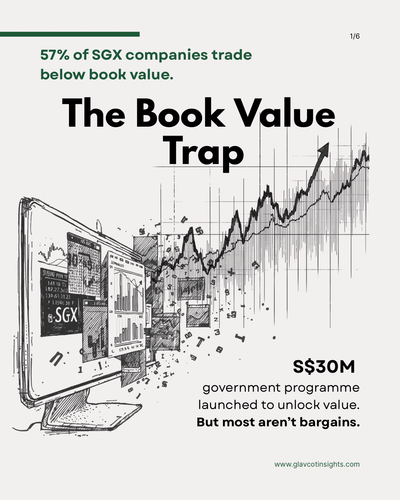
The Book Value Trap
Why 57% of SGX companies trading below book value aren't bargains—and what metrics actually reveal business quality for Singapore investors.
1 min read
Dec 19
Reading Ownership Composition: Advanced Insights
This is Part 2 of a two-part series on ownership structure. In Part 1, we explored why ownership matters and introduced three foundational signals every investor should evaluate. Here, we dive deeper—examining how ownership dynamics evolve over time
9 min read
Dec 12
Why Ownership Structure Matters More Than Most Investors Realize
This is Part 1 of a two-part series exploring how ownership structure shapes investment outcomes. In this first part, we'll establish the foundational framework—why ownership matters, the spectrum of ownership structures, and three key signals every investor should evaluate.