The Ticker Isn't the Business: Why Share Prices Tell You Less Than You Think
Most investors treat share prices like gospel. Down 15% in three months? Panic. Up 20% in a week? Euphoria. But here's what the market won't tell you: the price you see flashing across your screen is determined by less than 1% of the company's shares actually changing hands.
Most investors treat share prices like gospel. Down 15% in three months? Panic. Up 20% in a week? Euphoria. But here's what the market won't tell you: the price you see flashing across your screen is determined by less than 1% of the company's shares actually changing hands.1
Take DBS Group Holdings—one of Singapore's most widely held stocks and a cornerstone holding in the banking sector, itself among the most popular investment sectors. On any given day, roughly 4.8 million shares trade. Sounds substantial until you realize DBS has 2.84 billion shares outstanding. That's 0.17% of the company trading hands daily. The remaining 99.83%? Sitting quietly in portfolios, untouched by the day's drama.
Yet that 0.17% sets the "market price" for the entire enterprise.
The Tail Wagging the Dog
Think about what this means. When DBS shares drop 3% on a Tuesday afternoon, it's not because 2.84 billion shares suddenly became less valuable. It's because a tiny fraction of shareholders—perhaps spooked by a headline, rebalancing portfolios, or simply needing liquidity—decided to sell at a lower price than Monday's close.
The business behind the ticker didn't change. The bank's loan portfolio didn't deteriorate overnight. Its wealth management franchise didn't collapse. Customer deposits didn't vanish. But the share price moved because a sliver of the shareholder base traded with each other, and that sliver's consensus set the new "market value."
This is the fundamental disconnect investors must grasp: share prices reflect marginal trading activity, not intrinsic business worth.
Would You Sell Your Business for 15% Less?
Imagine you own a private business outright. You've built it over decades. It generates consistent cash flow, has loyal customers, employs skilled people, and operates with sound fundamentals. One day, someone offers you 15% less than what you paid for it three months ago.
Would you sell? Would you even consider it?
Of course not. You'd evaluate the business itself. Are customers still paying? Are margins intact? Is the competitive position secure? Is management executing the strategy?
If the answers are yes, you'd dismiss the offer as noise. Yet when that same business is publicly listed, retail investors watch a 15% price decline and assume something catastrophic must have occurred.
Nothing catastrophic occurred. A small percentage of shares traded at lower prices. That's all.
The Forces That Move Prices (But Don't Change Value)
Share prices respond to countless factors divorced from business fundamentals:
Institutional rebalancing. A pension fund shifts asset allocation. Millions of shares hit the market. Price falls. The business is unchanged.
Liquidity needs. A major shareholder requires cash for unrelated reasons. Shares get dumped. The business carries on.
Day traders, hedge funds, and algorithmic trading. Short-term speculators—often representing 10% or more of daily volume—react to technical signals, momentum strategies, and minute-by-minute price movements, not business fundamentals.
For DBS specifically, Temasek Holdings controls 29% of shares—effectively locked up capital that rarely trades. Large institutional holders like Vanguard and BlackRock might trade only at quarterly rebalancing. The "float" that actually determines daily prices is far smaller than the headline suggests.
You're watching price discovery happen among the most impatient, most leveraged, or most liquidity-constrained participants. That's who sets the ticker.
The Convergence: Price Eventually Finds Value
"In the short run, the market is a voting machine—but in the long run, it is a weighing machine." -Benjamin Graham
The voting machine counts hands raised by traders operating on sentiment and quarterly thinking. The weighing machine measures actual business results: earnings, cash generation, return on equity, competitive positioning. Over time, these converge.
DBS has delivered record profits, expanded its wealth management franchise across Asia, maintained best-in-class digital banking capabilities, and generated consistent double-digit returns on equity. When share prices temporarily diverge from these fundamentals—whether too low or too high—the weighing machine eventually corrects the voting machine.
This is why business owners sleep better than traders. Owners know the business will compound value if fundamentals remain sound, regardless of daily price fluctuations.
Thinking Like an Owner in a Ticker-Obsessed Market
The practical takeaway isn't to ignore share prices entirely. Price matters when you're buying or selling. But price should never be confused with value, and short-term price movements should never be mistaken for business health.
When DBS shares fall 15% over several months, the first question isn't "What's wrong with the stock?" It's "What's changed in the business?"
Has loan quality deteriorated? No. Have margins compressed beyond industry trends? No. Is management executing poorly? No. Has competitive positioning eroded? No.
If the business fundamentals remain intact—or better yet, have improved—then the share price decline represents opportunity, not risk. The market's voting machine is simply having a tantrum while the weighing machine continues its patient work.
The 0.17% Lesson*
Every time you check a stock price, remember: you're watching a tiny percentage of shares trade. That percentage might be informed. It might be panicked. It might be algorithmic. But it's always tiny.
The business behind those shares operates on a different timescale. Revenue doesn't pivot on hourly charts. Competitive advantages aren't built or destroyed in trading sessions. Management quality doesn't fluctuate with market sentiment.
When DBS shares fall 15% over several months, the first question isn't "What's wrong with the stock?" It's "What's changed in the business?" If fundamentals remain intact—or have improved—then the price decline represents opportunity, not risk.
The ticker isn't the business. Never has been, never will be.
*Note: The 0.17% figure is specific to DBS's typical daily trading pattern. Different stocks have varying volumes. During extraordinary events—such as the GameStop short squeeze in January 2021, when the entire float rotated multiple times in single days—daily trading can exceed 100% of float. However, these extreme episodes remain exceptions that prove the rule: prices are set by marginal trading activity, not comprehensive business valuations by majority shareholders.
A Note on Long-Term Patience**
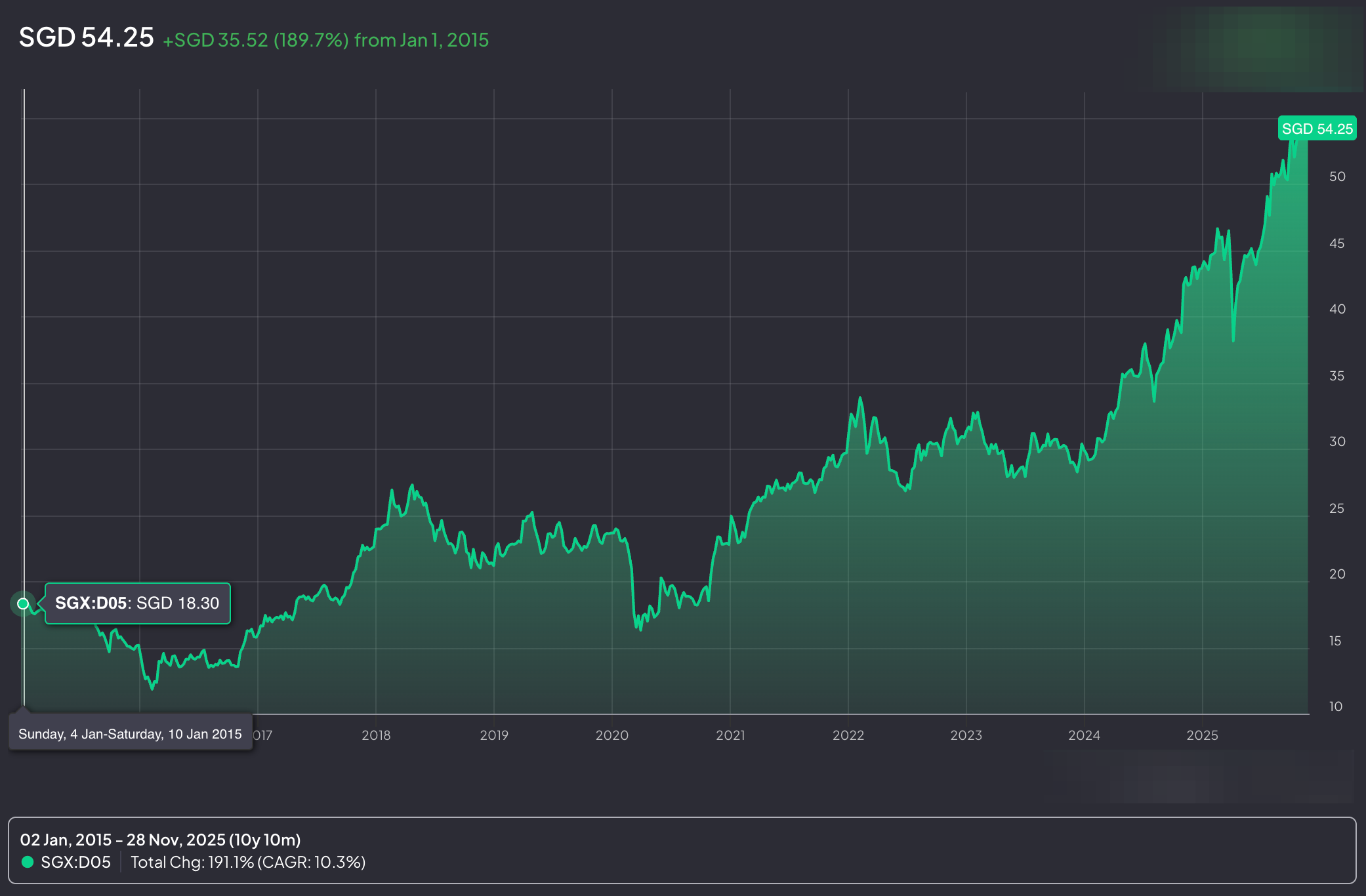
Consider the power of compounding: $1,000 invested in DBS shares ten years ago would be worth approximately $4,300 today with dividends reinvested—a 330% return. Extend that to fifteen years, and that same $1,000 becomes $7,600—a 660% return. Both periods included the Global Financial Crisis recovery, multiple bear markets, COVID-19 panic, interest rate scares, and endless daily volatility.
The business compounded. The share price followed. Everything else was noise.
For context, Singapore 10-year government bonds historically yielded 2-3% annually during this period. DBS's 16% CAGR (10-year) and 14.7% CAGR (15-year) significantly exceeded risk-free bond returns, demonstrating the premium available to patient equity investors willing to own quality businesses through volatility.
Based on share price alone, it shows 196.45% in price appreciation. This doesn't include dividends reinvested over 10 years.
** This example isn't investment advice to buy DBS—you'll need to conduct your own due diligence or consult your financial advisor. The point is simpler: share prices appreciate over the long term when the underlying business remains sound. Understanding the business behind the ticker makes holding through volatility easier. When you know what you own and why you own it, the 0.17% trading noise becomes exactly what it is—irrelevant.
References
1. DBS Group Holdings Ltd. (2024). Annual Report 2024 - Shareholding Statistics. Retrieved from DBS Investor Relations. [Total shares outstanding: 2,844,173,135 shares; Temasek Holdings ownership: 29.14%]
2. Google Finance. (2025). DBS Group Holdings Ltd (D05:SGX). Average trading volume: 4.81M shares (30-day average). Retrieved November 2025.
3. DBS Group Holdings Ltd. (2025). Shareholding Statistics as at 7 February 2025. Public float: approximately 71.62% of issued ordinary shares.
4. FinanceCharts. (2025). DBS Group Holdings (DBSDF) Total Return Data. 10-year total return: 330.93%; 10-year average annual return (CAGR): 16.03%. Retrieved November 2025.
5. Graham, B. (1949). The Intelligent Investor. Harper & Brothers. Disclosure: This article is for educational and informational purposes only and does not constitute investment advice. The author may hold positions in DBS Group Holdings or other securities mentioned. All investment decisions should be made based on your own research and consultation with qualified financial advisors. Past performance does not guarantee future results.
Where Clarity Meets Conviction
Glavcot Insights is now live. Join the free tier to get new research, updates, and future analysis directly in your inbox. (Check your spam folder if you don't see the confirmation email)
You might also like
Feb 06
Warren Buffett Doesn't Buy Gold. Over the Past Decade, That Would Have Been a Mistake.
— Unless you could do what he does.
A close friend asked me recently: "How does Glavcot Insights actually help
5 min read
Jan 01
TAYLOR SWIFT: THE ECONOMICS OF OVER-SERVING
"It is our job to make this look accidental, and it is our job to make this look effortless. I don't think of this as the pieces falling into place. You PUT the pieces where they are."
— Taylor Swift to her dancers and co-performers,The Eras Tour (Taylor's Version) documentary
That stopped me.
8 min read
Dec 23
The Book Value Trap
Why 57% of SGX companies trading below book value aren't bargains—and what metrics actually reveal business quality for Singapore investors.
1 min read
Dec 19
Reading Ownership Composition: Advanced Insights
This is Part 2 of a two-part series on ownership structure. In Part 1, we explored why ownership matters and introduced three foundational signals every investor should evaluate. Here, we dive deeper—examining how ownership dynamics evolve over time
9 min read
Dec 12
Why Ownership Structure Matters More Than Most Investors Realize
This is Part 1 of a two-part series exploring how ownership structure shapes investment outcomes. In this first part, we'll establish the foundational framework—why ownership matters, the spectrum of ownership structures, and three key signals every investor should evaluate.